Showing posts with label Kansas. Show all posts

Friday, April 5, 2013

Guest Post: Recollections of World War II from Marvin and Lois (Hahn) Ledy


Over the course of this year, we will sporadically feature stories on World War II from local Dickinson County residents, interviewed and written by Amy Feigley. 

MARVIN AND LOIS (HAHN) LEDY

Lois and Marvin Ledy
In 1941, Marvin Ledy was a high school student in Miltonvale, Kansas when Pearl Harbor was bombed. He had just returned home from church with his family when he heard the news. A few counties away, Lois Hahn, a high school student in Gypsum, Kansas, was at a movie when she heard the news. Like most Americans, they were scared and had no idea what was going to happen next after the bombing.

After the draft of 1942, Marvin registered, and was in the first group of nineteen year olds to be drafted from Dickinson County. He served our country as a part of the 738th Tank Battalion, from February 1943 until November 1945. Before Marvin was sent for training in Fort Benning, Georgia, he went on a blind date with a beautiful young lady by the name of Lois Hahn (his future wife), to the Plaza Theater in Abilene.  While at Fort Benning, Marvin worked the radios and telephone switchboards.

After Fort Benning, Marvin was sent to Fort Knox, Kentucky on May 1, 1943, for radio school. He then received his first furlough to come home in August 1943 and of course to go on another date with Lois. While at Fort Knox, he was issued an m3/Grant CDL tank in December 1943. In January 1944, Marvin then moved to Camp Bouse in Arizona. While there, he and his battalion trained with tanks at night. He came home in March 1944, on a ten day furlough, and married Lois Hahn. From there, he returned to the desert of Arizona and eventually went on to Fort Dix, New Jersey. “We weren’t at Fort Dix very long before we had to get a crew cut” says Ledy. “We were at Fort Dix for about three weeks before we boarded a ship, which was the first part of May in 1944. We shipped out on Marcatania and it took about eight days until we docked at Glasgow, Scotland.” From there, he and his crew rode a train to the very west side of Whales, where, as Marvin stated, the weather was very nice.

With Marvin away, Lois kept busy back home. She worked at Duckwall’s and then went on to work in the Welfare Department in the Courthouse. When Marvin returned home in 1945, she left her job. “During the war, everything was rationed. You had to have a coupon for pretty much everything from coffee to sugar and from shoes to gas. That is how we lived, from day to day not knowing if we were going to have something or not. But, we proudly did this for those serving our country” says Lois. “There were bond drives. That was the big thing, people would buy bonds.” During the war, the USO dances were held at a hotel basement in Abilene.

Wayne Barton and Marvin Ledy
On November 28, 1944, Marvin and his crew moved to Aachen, Germany, right before the Battle of the Bulge. They then moved to Belgium and were there until December 26, 1944 and eventually moved back to Stolberg, Germany after the battle. Marvin eventually made his way back to Aachen in March 1945. During the Battle of the Bulge, Lois did not hear from her husband for six weeks.

In August 1945, Marvin and his battalion returned home to the United States. “It was quite an episode getting off the ship in Boston to get back home to Abilene” explains Ledy. “Instead of going to Fort Leavenworth, we went to the Jefferson Barracks in St. Louis, Missouri. We got back to Abilene right during the fair, at 4:00 a.m. I walked home and surprised my family.  The communication back then was not like it is now.” Marvin’s family knew he was coming home, but just did not know when. 

During his war experience, Marvin received three battle stars: Battle of the Bulge, Rhineland and Central Europe, and 3 stripes for eighteen months overseas, 2 stars for his status as a T-5 Corporal and a good conduct medal. “When we were on our way back home on the ship, two A-bombs were dropped on Japan” states Geist. When Marvin returned home, he helped out on the farm before moving to Indiana to work at a wiring cable factory, which is the same job he had before the war. He and Lois moved back to Kansas in May 1946 to the farm and eventually to a farm near Talmage in March 1949. They resided on the farm until 1974.


Friday, February 22, 2013

The Kirby House: Losing an Abilene Landmark

Photo by Tim Horan, Abilene Reflector-Chronicle.
On Wednesday evening, February 20, 2013, Abilene lost a 128 year old landmark. The Kirby House had stood at 205 Northeast Third Street since 1885, and was a well-known Abilene staple. The Abilene Gazette reported on March 13, 1885, “County treasurer Kirby has let the contract for a $6,000 residence, to be erected on his beautiful ground on East 3d street. Abilene will boom the coming season.” During the past 128 years though, the Kirby House served as more than Thomas Kirby’s home, it was the meeting place of the Abilene Commercial Club, an apartment complex, and since 1987, a high quality and popular restaurant. The Kirby House was an important part of Abilene, and now it is gone.

Thomas Kirby
Thomas Kirby came to Abilene in 1872. The cattle town days were coming to an end, but Abilene was still a city of significant growth. Kirby began working as a bank cashier for another prominent Abilene figure, Conrad H. Lebold. Kirby quickly found success though, and opened the Kirby Bank in 1878. As Kirby’s successes grew, he purchased significant real estate, owning several city blocks in Abilene and land outside of the city as well. Kirby also had a philanthropic heart, and donated funds to build some significant projects in Abilene. He was influential in the building of Saint Joseph’s Academy (later Orphanage) north of town, and built Kirby Park, a small public area featuring a fresh Sand Springs Water fountain. Kirby Park was located near the corner of Northwest Second Street and Buckeye, the location of the Civic Center’s parking lot today. In addition to his work as a banker and philanthropist, Kirby also served two terms as county treasurer.

The Kirby House as it appeared during Thomas Kirby's lifetime.
In 1885, construction began on Kirby’s home which would house himself, his wife Anna, and their daughter Gertrude. Thomas would live in this home until his death in 1905. Anna continued to live in the family home until 1914, when she decided to sell the building to the Abilene Commercial Club, a forerunner to the Chamber of Commerce. Under this ownership, the home went under significant renovations. A dining hall was added to the northern side and the front tower was removed from the structure. Large pillars were added to create a new front porch entryway. The Commercial Club used the building for several years until 1930, at which time the home was divided into apartments.

The house after renovations from the Abilene Commercial Club.
Terry and Jerry Tietjens purchased the building in 1986 and after conducting research on the house’s history, decided to restore it to its original 1885 appearance. In 1987, the Kirby House opened as a fine dining restaurant. Since then, the restaurant saw a variety of owners, but remained an important and popular eating destination in Abilene.

The Kirby House may be gone now, but it will not be forgotten. The memories of wedding receptions, Valentine’s dates, or lunches with friends will remain; memories of the fun times we have shared in this historic Abilene building. Abilene has seen historic structures fall in the past; the Belle Springs Creamery, the Plaza Theater, and many more. Many of these losses cannot be predicted or avoided, such as the Kirby House fire. However, some can be prevented if we work towards preservation and restoration of our town’s historic structures. Together, we can keep our town’s history alive, instead of allowing it to come crashing down.

Note: To view more photographs related to Thomas Kirby and the Kirby House, visit our Facebook page.

Wednesday, January 9, 2013

Guest Post: Recollections of World War II

Doris and John Larson

Over the course of this year, we will sporadically feature stories on World War II from local Dickinson County residents, interviewed and written by Amy Feigley. 

The year was 1941. People were doing the East Coast Swing to Tommy Dorsey, the Andrew Sisters and Glenn Miller. Citizen Kane and Here Comes Mr. Jordan were drawing crowds to the movie theaters. Life was grand for all until that fateful Sunday in December when Pearl Harbor was bombed. Life suddenly changed for everyone. 

DORIS (HOOVER) LARSON 

For Doris Larson, helping with the war effort back home was something that she proudly did. She started working at Ehrsam’s in Enterprise at the end of 1943. “We got used to working a certain shift and then got rotated. I learned to run a lathe and a flange machine for a plane” says Doris. “I then worked in the drafting room and started to draw the legs for the elevators and punch boards.” 

Doris (Hoover) Larson enjoyed reminiscing about her high school days, when she met John (her future husband) and life was great. “We met at the fair in Abilene one night” says Larson. “When we were back at school, Glen Dalton passed me a note from John saying that he wanted a date with me. His parents were going to be in California and he was going to have a party. I knew that would not turn out well, so I didn’t go.” 

Fast-forward to 1941, for 20 year old Doris, this day would be embedded in her memory forever. “John was in the service and more and more men were being called into the service, including my brother Dale” says Larson. John was stationed in Olathe, then went to Virginia for training camp, then was off to San Diego, California and was eventually sent overseas to Okinawa, Japan, where he was a mine sweeper. 

While stationed, John was granted leave and returned to Olathe. On March 12, 1944, he and Doris were married. She took a leave of absence to be with her husband. When he returned overseas, she returned to Ehrsam’s and lived with her sister and brother-in-law Miriam and Loren Nichols. 

In 1945, John was granted another leave, this time to San Diego, California. Doris hopped on a train and joined him. Like most wives, she was anxious for the war to end and for her husband to return home. She eventually got her wish. 

When the war ended, Doris was pregnant with her daughter Susie. She was still working at Ehrsam’s, but left the company three weeks before Susie was born. John returned home from overseas on December 15, 1945 and eight days later on December 23rd, daughter Susie was born. Doris had many concerns when John returned home, such as where they were going to live and what was John going to do. John and Doris eventually rented a home near his folks and he began farming with his father. “We made that little house as homey as possible. There was no electrical power at all. We had a lamp from John’s grandmother that we used, as well as a lantern” said Doris. 

That next spring, Doris was anxious to plant a garden. John had borrowed a walking horse and plow and made a garden space for her. They eventually bought cattle from a neighbor so they would have milk, cream and butter and family members brought them pullets so they could have eggs. 

“Things are much easier now than they were back then. We did not have the conveniences that we do now. But, I would not have changed a thing.” Doris and John were married for 59 ½ years before he passed away. They raised two daughters together and shared a life of love and happiness, through good and bad times.

Friday, December 21, 2012

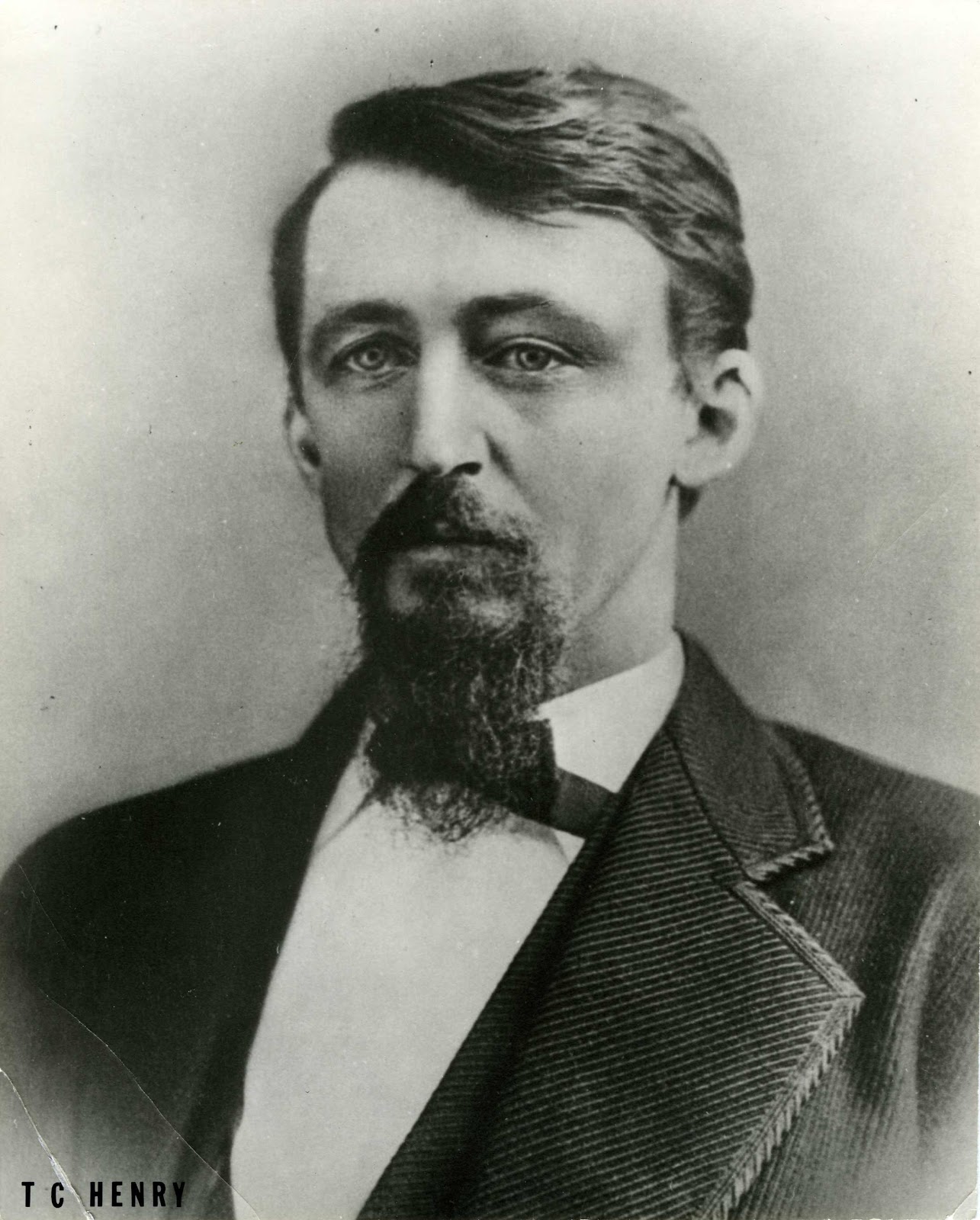
T.C. Henry: The Wheat King of Kansas

T.C. Henry
Abilene is a city with an eclectic history.  Whether it is the cattle trade, greyhound history, notable figures, or farming, the town has had many interesting stories and events over the years.  One of Abilene's more notable people from the cattle trade days was Theodore C. Henry.

We have featured the story of Joseph G. McCoy on this blog in the past, and interestingly enough, Henry's and McCoy's stories cross paths quite a bit.  Like McCoy, Henry was an Illinoisan and a successful businessman and entrepreneur.  Henry moved from Illinois to Abilene, Kansas to help promote McCoy's stockyards and also make a name for himself in real estate.  Henry would build a large financial standing through real estate over the next few years, and by 1870, he became the provisional mayor of Abilene.

During his time as Abilene's mayor, Henry would oversee the hiring of marshal Tom Smith, who finally brought law and order to the town after three hectic years of crime and lawlessness.  Smith would enforce a strict "no firearms" ordinance in Abilene and saw the closing of many of the town's brothels.

Though Henry had profited from the cattle trade and most definitely found success in his real estate business due to the influx of people moving to Abilene, he would eventually change allegiances in 1871, and help contribute to the anti-cattle trade group, the Farmers' Protective Association.  In the winter of 1871-1872, Henry drafted the following statement:

We the undersigned members of the Farmers' Protective Association and Officers and Citizens of Dickinson County, Kansas, most respectfully request all who have contemplated driving Texas Cattle to Abilene the coming season to seek some other point for shipment, as the inhabitants of Dickinson will no longer submit to the evils of the trade.

This statement was published in multiple Kansas and Texas newspapers, and it actually worked!  Over the course of 1867-1871, several other Kansas towns had caught onto Abilene's cattle town model and replicated it to great success.  Instead of Abilene, cattle drovers brought their herds to other Kansas towns like Ellsworth or Wichita.

Though the cattle were gone and the town was in a state of decline immediately following the end of the cattle trade, Henry still found great success.  Throughout the 1870s he experimented with planting Turkey red winter wheat, a crop that was commonly thought to not grow well in Kansas.  Henry had several large yields of the crop, and by the mid-1870s was known by many as the "Wheat King of Kansas."  The work of Henry can still be seen throughout Dickinson County as this is one of the most widely grown crops in the county (and the state as a whole).  Henry's large carriage house, which used to stand near the corner of 14th and Buckeye streets in Abilene, can still be seen today at Old Abilene Town.

Wednesday, November 14, 2012

Heritage Art Show to Begin on February 3

The Heritage Center will host the 5th Annual Heritage Art Show from February 3 through February 10. This show will present works of art from Dickinson County students. 

There will be an opening reception held at the museum on Sunday, February 3, 1:00pm to 4:00pm. Cookies will be served for all who attend.

Friday, November 9, 2012

Kansas Statehood Ball Scheduled for January 26

Come celebrate the 152nd birthday of the state of Kansas at the Kansas Statehood Ball sponsored by the Dickinson County Historical Society on Saturday, January 26 at Sterl Hall in Eisenhower Park from 7:00pm to 10:00pm. 

This will mark the 18th year of this popular event for the whole family. The public is invited to dress in period (1860s) clothing but this is not mandatory. Admission for the dance will be $5.00 per adult, $3.00 for members of the Historical Society, and $2.00 for children (3 to 12 years of age). 

The Kansas Statehood Ball is an educational program provided by the Dickinson County Historical Society. Come and enjoy an evening filled with music and dance. Refreshments will be provided, but we would greatly appreciate any members who can bring a dozen cookies to serve to our guests. Our next newsletter will have more information on this entertaining event.

Monday, October 8, 2012

"C.L. Brown and Kansas Independent Telephony" is Now on YouTube

Back in July, the Dickinson County Historical Society premiered our short documentary film, C.L. Brown and Kansas Independent Telephony.  The film highlights the life of C.L. Brown, a utilities entrepreneur and humanitarian who gave back to the Kansas public in fantastic ways during his life.  Today, the independent telecommunications companies continue this tradition set forth by Brown, by giving to their communities as well.  You can watch the film below:


Principal funding for this program is provided by the Kansas Humanities Council, a nonprofit cultural organization promoting understanding of the history, traditions, and ideas that shape our lives and build community.

Monday, September 24, 2012

Special Traveling Exhibit to Highlight the Orphan Train Riders to Kansas

We are very pleased to announce that the Dickinson County Heritage Center will be host to the traveling exhibit Orphan Train Riders to Kansas, October 6th through October 31st.

This special exhibit is made possible by the Thelma Starr Workman Estate, the Humanities Division of Cloud County Community College, and the National Orphan Train Complex.

The National Orphan Train Complex in Concordia (which manages the National Orphan Train Museum) had this to say about the exhibition: “The exhibit will feature photographs and information from the Anna Laura Hill collection. Hill was a placing agent during the Orphan Train Movement, making 163 trips to Kansas to place children.

“The exhibit will also incorporate photographs from depot scrapbooks that were compiled by the late Thelma Starr Workman. Workman was a teacher at Cloud County Community College for 28 years, and published a number of poetry, fiction, and local historical books. She was also a collector and promoter of local history, and a columnist for the local newspaper.”

The National Orphan Train Museum is dedicated to the preservation of stories and artifacts of those who were part of the Orphan Train Movement. The museum features displays of Orphan Train Riders, families who took the children, placement agencies and the agents who accompanied the children on the trains, and the more recent history of collecting the stories.

Thursday, August 30, 2012

Upcoming Exhibit at the Jeffcoat Museum to Focus on the Studio's History

The Jeffcoat Photography Studio Museum in Abilene, Kansas is proud to announce a new exhibition highlighting the history of three generations of photographers in the Jeffcoat Studio family business.

Before the turn of the twentieth century, Lucy Fritz Jeffcoat trained herself in camera operation and retouching photographs.  She quickly found work for several photographers in the Abilene area.  Lucy was also the mother of four children, so she did most of her photographic work from her home.  Her son, Paul, became interested in the photographic process at a young age.  He began delivering his mother’s retouched photographs and was fascinated with the developing process.

Paul went into business as the Jeffcoat Photography Studio in 1921.  At the time, the studio was located in a small second story room in downtown Abilene.  The business soon outgrew this space, and Paul built a new building for the business in 1925.  This building still stands today, and is the current home of the Jeffcoat Photography Studio Museum.

Paul saw his business through the Great Depression, and was able to supplement his income by partitioning his building and renting half of his property to other area businesses.  Over the years, the north side of the building would be occupied by an optometrist, an insurance agency, and a shoe repairman.  The sound of pounding hammers repairing shoes could be a bit distracting during portrait sessions, but having these businesses next door helped the Jeffcoat Studio immensely. 

Paul passed the trade of photography down to his son, Bill.  Throughout his life, Bill was interested in documenting life and events in his hometown of Abilene.  Bill photographed several parades, visits from President Eisenhower, and of course, family portraits.  He enjoyed photography outside of his professional work, walking around Abilene and snapping pictures of anything that caught his eye.  His father, Paul, saw this differently.  He once told his son not to take photographs unless he could make an income from the image.  Bill would continue taking snapshots, choosing to develop his film at night to keep it a secret from his father.

Though the Jeffcoat Studio was primarily a portrait studio, the Jeffcoats were able to document the history of the Abilene area, creating images that will last several years to come.  The Jeffcoat Photography Studio Museum’s newest exhibit, The Family Behind the Lens: A Retrospective of the Jeffcoat Studio, begins on September 1 and runs through November 20.

You can learn more about the history of the Jeffcoat Studio and the history of Abilene by visiting the Jeffcoat Photography Studio Museum at 321 N. Broadway Street in Abilene.  For hours of operation or to schedule a private viewing, contact the museum at (785) 263-9882 or jeffcoatstudio@att.net.  Be sure to visit the museum’s website at jeffcoatstudio.com and their Facebook page at facebook.com/jeffcoatstudio.

Wednesday, August 15, 2012

Historical Bicycle Tour Coming Up in Abilene

The Dickinson County Historical Society will once again be conducting a historical bicycle tour of downtown Abilene.  This tour benefits the Quality of Life Coalition, and will be held on August 24, 2012 at 7:00pm.


Wednesday, July 25, 2012

Great Interaction at our Short Film Premiere

Our premiere's audience.
For the past seven months, the Dickinson County Historical Society has been working on a short film highlighting the life of C.L. Brown and his lasting legacy of community giving that still exist in Kansas independent telephone companies today. On Saturday, July 21, 2012, we premiered the fifteen-minute film, C.L. Brown and Kansas Independent Telephony, to a crowd at the Eisenhower Presidential Library auditorium. I was hoping for a good-sized crowd for the event. What we got far exceeded my expectations.

That evening, we totaled 165 guests for the film screening. That’s right, 165 people. This total was more than would fit in the auditorium’s seats, but staff at the Eisenhower Presidential Library graciously set up additional chairs so everyone in attendance could have a place to sit.

After the screening, we also held a panel discussion focusing on the history of C.L. Brown, community engagement, and how the short film was made. I was very pleased with the variety of questions our audience posed and the many stories that were shared during the discussion. Many of our audience and their families have strong memories of the Brown Memorial Park, so it was fascinating to hear those people reminisce about the past.

After the discussion, we hosted our annual Ice Cream Social at the Dickinson County Heritage Center. This was probably the largest crowd we have ever hosted for this event. Our museum was a packed house, but everyone seemed to be in high spirits throughout the evening.

I would like to thank everyone who helped make this short film and event a success, and would like to thank our society’s membership for coming out in full force Saturday night. If you were not in attendance, we will be announcing other ways to view the short film very soon.

For another take on this evening, be sure to read the Abilene Reflector-Chronicle’s writeup on the event. 

Principle funding for this program is provided by the Kansas Humanities Council, a nonprofit cultural organization promoting understanding of the history, traditions, and ideas that shape our lives and build community.

Wednesday, June 27, 2012

Memories of the Prairie Lecture Series: Presentation Explores Kansas Opera Houses

The Dickinson County Historical Society and the Heritage Homes Association of Dickinson County in Abilene will host “Kansas Opera Houses and Community Events,” a presentation and discussion by Jane Rhoads on Saturday, June 30 at 7 pm  at the Dickinson County Heritage Center located at 412 S. Campbell St.  Members of the community are invited to attend the free program.  Contact the Heritage Center at 263-2681 for more information.  The program is made possible by the Kansas Humanities Council.

 This program is part of the Memories of the Prairie Lecture Series presented by the Dickinson County Historical Society. All the programs are free, however donations are always welcomed.  You are also invited to become a member of the Dickinson County Historical Society to help support the continuing efforts to preserve the heritage of Dickinson County.

From melodrama to Shakespeare, from church socials to high school commencements, the opera houses of Kansas made significant contributions to the state’s social and cultural fabric in communities both large and small.  Rhoads will discuss the history of opera houses in Kansas and how they are being used today.

Rhoads is an author and a 2009 Notable Kansas Book award winner.  Her book, “Kansas Opera Houses, Actors, and Community Events 1855-1925” is the result of years of travel across Kansas to research opera houses.

“I came to love opera houses when as a small child I played in the opera house built by my great-grandfather,” shared Rhoads.  “This eventually led to my visiting 400 Kansas communities to learn about the activities that took place in the local opera houses and to photograph the state’s remaining ones.”

“Kansas Opera Houses and Community Events” is part of the Kansas Humanities Council’s Kansas Speakers Bureau featuring presentations and discussions about Kansas and what it means to be a Kansan over time and across generations.                         

The Kansas Humanities Council conducts and supports community-based programs, serves as a financial resource through an active grant-making program, and encourages Kansans to participate in their communities.  For more information about KHC programs contact the Kansas Humanities Council at 785-357-0359 or visit online at www.kansashumanities.org.

For more information about “Kansas Opera Houses and Community Events” in Abilene contact the Dickinson County Historical Society at 785-263-2681 or visit www.heritagecenterdk.com.

Wednesday, June 20, 2012

Memories of the Prairie Lecture Series: Presentation Explores Kansas Frontier Photographer

The Dickinson County Historical Society in Abilene, Kansas along with the Jeffcoat Photography Studio Museum will host "Kansas Through the Lens of F.M. Steele," a presentation and discussion by Jim Hoy on Saturday, June 23 at 7:00pm at the Dickinson County Heritage Center located at 412 S. Campbell Street in Abilene.  Members of the community are invited to attend the free program, and can contact the Dickinson County Historical Society at (785) 263-2681 for more information.  This program is made possible by the Kansas Humanities Council.

In 1890, frontier photographer Francis Marion Steele set out from Dodge City to record cowboys, American Indians, wildlife, wheat harvesting, grain farming, sugar-beet factories, railroad building, community celebrations and festivals, small-town life, and studio portraits.  Hoy's presentation examines how Steele's work provides visual documentation of the Kansas character.

Jim Hoy is a professor of English and director of the Center for Great Plains Studies at Emporia State University.  He is an authority on the folklife of ranching, a topic on which he has lectured throughout the world.  Hoy's publications include ten books and over one hundred articles, and he is co-author of "Plains Folk," a syndicated newspaper column.

"Francis Marion Steele arrived in Dodge City in 1890 and immediately set out onto the prairies in a dark-room-mounted buggy to take photographs of cowboys," shared Hoy.  "After the end of the open range he photographed everything from wheat farming to railroad construction to small-town life, providing in the process documentation of Kansas and the southwestern plains in the transition from the open range to crop agriculture."

"Kansas Through the Lens of F.M. Steele" is part of the Kansas Humanities Council's Speakers Bureau featuring presentations and discussions about Kansas and what it means to be a Kansan over time and across generations.

The Kansas Humanities Council conducts and supports community-based humanities programs, serves as a financial resource through an active grant-making program, and encourages Kansans to participate in their communities.  For more information about KHC programs contact the Kansas Humanities Council at (785) 357-0359 or visit online at www.kansashumanities.org.

Wednesday, June 13, 2012

Guest Post: From Enterprise, Kansas to the Brooklyn Dodgers

Today's post is brought to you by Amy Feigley. Amy is a member of the Dickinson County Heritage Center staff, and also works as a paraprofessional educator. In today's post, Amy tells us the history of Zach Wheat, a professional baseball player who spend some time in Enterprise, Kansas.

The year was 1906. Enterprise was a town that offered you about anything a resident could ever ask for, with the exception of a baseball team.

And, it was in 1906, the year of Aristotle Onasis and the San Francisco Earthquake, that Zach Wheat, a Missouri native all of 18 years, got his start in what would span as a 19 year professional baseball career.

Zach was invited to play on the Hoffman Mills baseball team and was brought to Enterprise by Ralph Hoffman. Ralph was not only interested in Wheat's amazing talent for baseball, but also to bring this town a great sport, something for the whole family to partake in.

After a year in Enterprise, Zach continued his career in this great All-American sport in Wichita. From there he played for the Shreveport Pirates in 1908 and then finished up his minor career with the Mobile Sea Gulls in 1909. It was during his 1909 career that Wheat was purchased by the Brooklyn Superbas for the price of $1,200. And it was in September 1909 that he made his major league debut.

After his release from the Brooklyn Dodgers in 1927, he was signed by the Philadelphia Athletics. After that season, he was released and played for a minor league team by the name of the Minneapolis Millers. Due to a heel injury, he retired from baseball the following season.

To this day, Zach Wheat still holds records for hits, doubles, triples and total bases for the Dodgers franchise.

If you ever venture onto the stretch of Route 13 that runs though Caldwell County, Missouri, you will find yourself on the Zach Wheat Memorial Highway. And, if you are ever in Enterprise at the baseball diamonds, make sure you pay close attention to the name of the baseball field.

Zach Wheat left a great legacy for the love of baseball that still continues today. And, to think, he got his start in Enterprise, Kansas.

Thursday, May 31, 2012

Memories of the Prairie Lecture Series: Henry Varnum Poor: Commemorating 125 Years

The Dickinson County Historical Society will host its 18th Annual Memories of the Prairie lecture series beginning Saturday, June 2 at 7:00 pm at the Dickinson County Heritage Center, located at 412 S. Campbell St. in Abilene, Kansas. This lecture series will continue every Saturday night this summer through July 21.

On Saturday June 2, Ron Michael will speak about Chapman, Kansas native Henry Varnum Poor, who was one of the most recognized names in American art during the mid-1900s. This year marks the 125th anniversary of his birth, and the Birger Sandzén Memorial Gallery in Lindsborg, where Michael is curator, will feature an exhibition of Poor's work from July 8 until September 30, 2012. The exhibition will be composed of art from the Sandzén Gallery's collection and other regional institutions.

During his talk, Michael will discuss Poor's upbringing and family in Chapman along with his development as an artist. He was a noted painter, potter, writer, architect, and builder. Following his childhood spent in Chapman and Kansas City, Poor attended college at Stanford University and lived in California until 1919. He left for the East Coast that summer and the following year designed and constructed his own home and studio in New City, New York. Poor was actively involved in the national art scene, exhibiting his work and doing commissions throughout the United States. Additionally, he served as a teacher and helped found the Skowhegan School of Painting and Sculpture in Maine.

Ron Michael has served as curator of the Birger Sandzén Memorial Gallery in Lindsborg for over 15 years. He has presented many talks on Kansas artists and has developed exhibitions from the Gallery's collection of art.

In addition to working as curator, Michael is an artist who has shown in many regional and national exhibitions and has taught art courses at Bethany College in Lindsborg.

In the spring of 2000, Michael received a Master of Fine Arts degree in Design from the University of Kansas. Prior to working at the Sandzén Gallery and attending school at KU, he was a reference librarian for the California College of Arts and Crafts in Oakland, California. In 1995, he received a Master’s Degree in Library Science and Information Management from Emporia State University.

Michael grew up in Denver, Colorado, and holds a Bachelor of Fine Arts degree in Art and a Bachelor of Arts degree in Radio, TV and Film from Fort Hays State University.

The Memories of the Prairie lecture series is part of the Continuing Education Program of the Dickinson County Historical Society. Admission is free, but donations are always welcome. The Dickinson County Historical Society would like to invite you to become a member to help support the programs and activities throughout the year.

For more information on this week’s program or about becoming a member of the Dickinson County Historical Society please contact the Heritage Center at 785-263-2681 or visit our website.

Friday, July 8, 2011

Matt Visits the Wonders of Kansas #1: The Kansas Museum of History

Every now and then, I will be visiting locations that were selected for the Kansas Sampler Foundation’s 8 Wonders of Kansas lists.  The Kansas Museum of History in Topeka was selected as a top 8 Wonder of History.

I recently paid a visit to the Kansas Historical Society’s Museum of History over the Independence Day holiday weekend.  It had been a while since my last visit to the museum (I believe I was in Middle School the last time I toured the place).  It has been interesting to visit other museums over the past year to say the least.  Since I began working in a museum, I feel that I look at other museums in a new light.  I am not just there to learn about the historical narratives that the exhibits teach me, I am also there to see how the museum and exhibits are constructed, and get new ideas for the future.  

The Kansas Historical Society has a fantastic space for their museum.  The ceilings are very high, allowing them to feature many large and tall artifacts such as a windmill, covered wagon, Native American tipi, airplane, and of course, a train.  If I have one critique about an element of the museum’s exhibits, it is that some of the exhibit labels are difficult to read.  Now this can partly be attributed to lighting, however many artifacts on display cannot have direct light on them.  The museum would definitely not want to cause accelerated light damage, so changing the lighting would not be the solution.  One possibility would be to change the coloring of some of the labels.  I think this would help quite a bit.

But I am not writing this to complain about exhibit minutiae, I am here to promote history!  If you have never been to the museum, it begins with a fascinating look at Native American life in Kansas.  This area of the museum features many American Indian tools, and a Plains Indian grass lodge and tipi.  It is difficult to describe how cool it is to see a tipi actually made from bison hides.  Pending on the size of the tipi, it could take twelve to sixteen hides to make the outer covering of a tipi.  If you think about the process and hard work it took to create something like this, it is truly amazing.

The museum also features interesting exhibits on the Santa Fe Trail, Oregon Trail, and Bleeding Kansas.  The Bleeding Kansas period has always held special interest to me.  It is incredible to look at how Kansas was at the forefront of national politics (and people were killing each other over these issues!).  I feel the museum does a good job of showing both sides of the story, and showing how many people were invested in their respective causes during that period in time.

The train, in which you can walk through a section, is probably the museum’s superstar.  Inside the drover’s car, visitors can learn a little bit about the Kansas cattle towns and Joseph McCoy.  Outside of the train are many artifacts relating to changing technology and town growth.  

Probably my favorite part of my visit was getting to see the museum’s current exhibit in their temporary gallery.  The exhibit is entitled 150 Things I Love about Kansas, and will be on display for the remainder of this year.  The exhibit features a plethora of objects related to what makes Kansas great.  Most notable for me was a dress worn by Carry Nation.  Also featured was a painting of the famous hatchet-wielding woman, painted after her visit to the town of Enterprise in Dickinson County.  In the painting, her face is bruised due to women attacking her while she was in Enterprise to smash up Schilling’s Saloon.  It was such a cool piece of history to see, since I already knew the story of her visit to the town.  Fascinating stuff to see.

If you have never visited the Kansas Historical Society, be sure to do so.  I have only scratched the surface of what you can see in this blog post.  Also, if you have seen the museum before, I highly recommend returning, so you can see the current exhibit.

To learn more about the Kansas Museum of History and the Kansas Historical Society, be sure to visit their website

Kansas 150 Film Series

The Dickinson County Heritage Center has been showing movies related to Kansas history once a month throughout this year.  We have had a great turnout for all of these events so far.  Over one hundred people came to the museum to see June's movie, which was Surviving the Dust Bowl: The American Experience.  If you live in the Abilene area, we would love to see you at the rest of these historical film showings.  All films begin at 2:00pm on their respective dates.

July 17: The Wild West Cowboys
August 21: Mr. Sear's Catalog
September 18: The West of Charles Russell
October 16: The Railroad: Transcontinental, 1865-1880; The Railroad: The Golden Age, 1880-1916
November 20: The Real West

Tuesday, May 24, 2011

8 Wonders of Kansas Guidebook, Kansas Tourism

The Kansas Sampler Foundation began the 8 Wonders of Kansas project in 2007.  For those of you who know nothing about this program, the public were encouraged to vote for their favorite attractions in Kansas.  For the first contest, the public chose from twenty-four finalists, these eight wonders:

Big Well, Greensburg
Castle Rock and Monument Rocks, Gove County
Cheyenne Bottoms and Quivira National Wildlife Refuge, Barton and Stafford Counties
Dwight D. Eisenhower Presidential Library and Museum, Abilene
Kansas Cosmosphere and Space Center, Hutchinson
Kansas Underground Salt Museum, Hutchinson
St. Fidelis Church (also known as the Cathedral of the Plains), Victoria
Tallgrass Prairie National Preserve, Chase County

Over the next few years, the Kansas Sampler Foundation compiled many more votes and formed eight additional lists focusing on Kansas architecture, art, commerce, cuisine, customs, geography, history, and people.  Including all of the finalists and those picked for the original 8 Wonders list, this creates 216 different places to visit in Kansas.

The Eisenhower Presidential Library has been displaying an exhibit focused on these many attractions throughout this year, and will continue to do so until September 5, 2011.  Recently, the Kansas Sampler Festival also released a guidebook focusing on the many wonders of Kansas.  More information on this book can be found here.  This is a fantastic book that not only features a plethora of information on some interesting things to do and see in Kansas, but also features some amazing photographs of each and every place included on the list. 

It always baffles me when I hear people say that there is nothing to do in Kansas, or that Kansas is a boring place to live.  If you truly believe this, you are not trying hard enough to find activities for yourself.  Do you like museums?  Kansas has several.  Do you like the outdoors?  Well Kansas has many scenic places to visit (Monument Rocks and the Flint Hills are just two examples).  Many Kansas communities have art shows, incredible music festivals, live theatre, and sporting events.  This list could go on and on.  The point is, there are plenty of things to do in Kansas, if you just get out and do them.

This summer, I am going to try to visit a number of the attractions featured in the Kansas Sampler Foundation's 8 Wonders of Kansas Guidebook.  As I visit these, I plan to take some photographs and write a blog post about each of these places I visit (a few places will be pretty easy since I live in Abilene, and our community has a number of attractions featured in the book).

I have lived in Kansas my entire life.  I love learning new things about Kansas history, and I consider myself at least somewhat knowledgeable about the history of my state.  However, there are many places in Kansas that I have never been to, and many things I know nothing about.  I plan to change that.

Sunday, March 6, 2011

Interesting Exhibit on Display at the Eisenhower Presidential Library


I paid a visit to the Eisenhower Presidential Library and Museum a couple of weeks ago.  It had been quite a while since I had last toured the museum, library, and boyhood home, so it was nice to see everything with a fresh perspective again.  

A new exhibit this year at the library features the 8 Wonders of Kansas in celebration of the state’s sesquicentennial.  It’s a really interesting exhibit that features several photographs and artifacts related to the Kansas Sampler’s many 8 Wonders lists.  More information can be found at the Kansas Sampler and the Eisenhower Presidential Library and Museum websites.  If you have not gotten a chance to see this exhibit, I highly recommend it.  It is free to see this particular exhibit and will be on display until September 5, 2011.

Tuesday, January 25, 2011

The Statehood of Kansas

In case you didn't realize, January 29 marks the 150th anniversary of the statehood of Kansas.  To commemorate Kansas Day, this week's post is devoted to the story of the state.  If you are a member of the Dickinson County Historical Society, you may have already read this, since it was printed in our recent newsletter.  Nevertheless, enjoy!


This year marks the 150th anniversary of the statehood of Kansas.  Just a few years before becoming a state, the area that became Kansas went through a major transformation as communities grew and as the state government became established.

Primarily, the people seen in the Kansas region prior to 1854 were travelers passing through, traders, soldiers, missionaries, and Native Americans.  For several years explorers such as Zebulon Pike, Stephen Long, and John Frémont passed through, and trails such as the Santa Fe and Oregon Trails promoted trade and expansion in the land west of Kansas.  People were coming to Kansas, but not to live there.  Several Native American tribes were forced onto the land due to the Indian Removal Act of 1830.  For several years, Kansas was considered an Indian Territory, and therefore was uninhabitable for settlers moving west.

In May 1854, the Kansas-Nebraska act opened Kansas and Nebraska as United States territories.  Also important to Kansas’ future, this bill allowed for settlers of a territory to determine if their state would enter the union as a free or slave state.  At the time of this bill’s creation, many assumed Kansas would become a slave state since neighboring Missouri was one.

Communities quickly began to grow throughout the Kansas territory.  Notably for the area that would become Dickinson County, George Freeman became the first settler of Dickinson County in 1855, and in 1857 Mr. and Mrs. Timothy Hersey organized a little town named Abilene along the bank of Mud Creek.
Even though Kansas was not close to gaining statehood, the discussion of whether Kansas would allow slavery instantly became a topic of discussion.  Antislavery groups from the east sent people to Kansas soon after it became a territory.  Several proslavery individuals moved to the territory as well.  Relations between these two groups began peacefully, but problems quickly arose.
             
On more than one occasion, Border Ruffians from Missouri illegally voted in Kansas elections for proslavery candidates.  In an 1855 election, 6,307 men voted even though there were only 2,905 eligible Kansas men of voting age (women were not allowed to vote at this time).

Blood began to be shed on both sides.  In 1856, the Free State headquarters in Lawrence was attacked.  Two newspaper offices were destroyed, and several stores were looted by a proslavery group.  Later that same year, Free-Stater John Brown and his men killed five proslavery supporters in Franklin County.  This event would infamously be known as the Pottawatomie Creek Massacre.  Attacks like these continued to happen for quite some time.  Even after Kansas gained statehood, William Quantrill and his men attacked Lawrence in 1863, burning many buildings to the ground and killing almost every person in sight.  With violence such as this occurring as early as 1856, one could argue that the Civil War actually began in Kansas.  With tension rising and attacks occurring more and more, it is easy to see why the territory and state were known as Bleeding Kansas during this time period.
             
In July 1859, the fourth constitutional convention of Kansas met in Wyandotte (now part of Kansas City).  Here, delegates completed the Kansas constitution and approved Kansas entering the union as a free state.  Later that year a provisional state government was elected.  However, the Kansas constitution was not approved by the United States Senate since it would mean Kansas would be a free state.  With many proslavery senators against this, Kansas statehood was delayed for over a year.
             
In January 1861, the South seceded from the union, and the Kansas bill was quickly passed by the remaining congress.  On January 29, 1861 the bill was signed by outgoing President James Buchanan, and Kansas became a state.  There was a great deal of celebration, but with the Civil War on the horizon, there was also a great deal of uncertainty of what would happen to Kansas and the rest of the United States in the future.