Showing posts with label History. Show all posts

Friday, April 5, 2013

Guest Post: Recollections of World War II from Marvin and Lois (Hahn) Ledy


Over the course of this year, we will sporadically feature stories on World War II from local Dickinson County residents, interviewed and written by Amy Feigley. 

MARVIN AND LOIS (HAHN) LEDY

Lois and Marvin Ledy
In 1941, Marvin Ledy was a high school student in Miltonvale, Kansas when Pearl Harbor was bombed. He had just returned home from church with his family when he heard the news. A few counties away, Lois Hahn, a high school student in Gypsum, Kansas, was at a movie when she heard the news. Like most Americans, they were scared and had no idea what was going to happen next after the bombing.

After the draft of 1942, Marvin registered, and was in the first group of nineteen year olds to be drafted from Dickinson County. He served our country as a part of the 738th Tank Battalion, from February 1943 until November 1945. Before Marvin was sent for training in Fort Benning, Georgia, he went on a blind date with a beautiful young lady by the name of Lois Hahn (his future wife), to the Plaza Theater in Abilene.  While at Fort Benning, Marvin worked the radios and telephone switchboards.

After Fort Benning, Marvin was sent to Fort Knox, Kentucky on May 1, 1943, for radio school. He then received his first furlough to come home in August 1943 and of course to go on another date with Lois. While at Fort Knox, he was issued an m3/Grant CDL tank in December 1943. In January 1944, Marvin then moved to Camp Bouse in Arizona. While there, he and his battalion trained with tanks at night. He came home in March 1944, on a ten day furlough, and married Lois Hahn. From there, he returned to the desert of Arizona and eventually went on to Fort Dix, New Jersey. “We weren’t at Fort Dix very long before we had to get a crew cut” says Ledy. “We were at Fort Dix for about three weeks before we boarded a ship, which was the first part of May in 1944. We shipped out on Marcatania and it took about eight days until we docked at Glasgow, Scotland.” From there, he and his crew rode a train to the very west side of Whales, where, as Marvin stated, the weather was very nice.

With Marvin away, Lois kept busy back home. She worked at Duckwall’s and then went on to work in the Welfare Department in the Courthouse. When Marvin returned home in 1945, she left her job. “During the war, everything was rationed. You had to have a coupon for pretty much everything from coffee to sugar and from shoes to gas. That is how we lived, from day to day not knowing if we were going to have something or not. But, we proudly did this for those serving our country” says Lois. “There were bond drives. That was the big thing, people would buy bonds.” During the war, the USO dances were held at a hotel basement in Abilene.

Wayne Barton and Marvin Ledy
On November 28, 1944, Marvin and his crew moved to Aachen, Germany, right before the Battle of the Bulge. They then moved to Belgium and were there until December 26, 1944 and eventually moved back to Stolberg, Germany after the battle. Marvin eventually made his way back to Aachen in March 1945. During the Battle of the Bulge, Lois did not hear from her husband for six weeks.

In August 1945, Marvin and his battalion returned home to the United States. “It was quite an episode getting off the ship in Boston to get back home to Abilene” explains Ledy. “Instead of going to Fort Leavenworth, we went to the Jefferson Barracks in St. Louis, Missouri. We got back to Abilene right during the fair, at 4:00 a.m. I walked home and surprised my family.  The communication back then was not like it is now.” Marvin’s family knew he was coming home, but just did not know when. 

During his war experience, Marvin received three battle stars: Battle of the Bulge, Rhineland and Central Europe, and 3 stripes for eighteen months overseas, 2 stars for his status as a T-5 Corporal and a good conduct medal. “When we were on our way back home on the ship, two A-bombs were dropped on Japan” states Geist. When Marvin returned home, he helped out on the farm before moving to Indiana to work at a wiring cable factory, which is the same job he had before the war. He and Lois moved back to Kansas in May 1946 to the farm and eventually to a farm near Talmage in March 1949. They resided on the farm until 1974.


Friday, February 22, 2013

The Kirby House: Losing an Abilene Landmark

Photo by Tim Horan, Abilene Reflector-Chronicle.
On Wednesday evening, February 20, 2013, Abilene lost a 128 year old landmark. The Kirby House had stood at 205 Northeast Third Street since 1885, and was a well-known Abilene staple. The Abilene Gazette reported on March 13, 1885, “County treasurer Kirby has let the contract for a $6,000 residence, to be erected on his beautiful ground on East 3d street. Abilene will boom the coming season.” During the past 128 years though, the Kirby House served as more than Thomas Kirby’s home, it was the meeting place of the Abilene Commercial Club, an apartment complex, and since 1987, a high quality and popular restaurant. The Kirby House was an important part of Abilene, and now it is gone.

Thomas Kirby
Thomas Kirby came to Abilene in 1872. The cattle town days were coming to an end, but Abilene was still a city of significant growth. Kirby began working as a bank cashier for another prominent Abilene figure, Conrad H. Lebold. Kirby quickly found success though, and opened the Kirby Bank in 1878. As Kirby’s successes grew, he purchased significant real estate, owning several city blocks in Abilene and land outside of the city as well. Kirby also had a philanthropic heart, and donated funds to build some significant projects in Abilene. He was influential in the building of Saint Joseph’s Academy (later Orphanage) north of town, and built Kirby Park, a small public area featuring a fresh Sand Springs Water fountain. Kirby Park was located near the corner of Northwest Second Street and Buckeye, the location of the Civic Center’s parking lot today. In addition to his work as a banker and philanthropist, Kirby also served two terms as county treasurer.

The Kirby House as it appeared during Thomas Kirby's lifetime.
In 1885, construction began on Kirby’s home which would house himself, his wife Anna, and their daughter Gertrude. Thomas would live in this home until his death in 1905. Anna continued to live in the family home until 1914, when she decided to sell the building to the Abilene Commercial Club, a forerunner to the Chamber of Commerce. Under this ownership, the home went under significant renovations. A dining hall was added to the northern side and the front tower was removed from the structure. Large pillars were added to create a new front porch entryway. The Commercial Club used the building for several years until 1930, at which time the home was divided into apartments.

The house after renovations from the Abilene Commercial Club.
Terry and Jerry Tietjens purchased the building in 1986 and after conducting research on the house’s history, decided to restore it to its original 1885 appearance. In 1987, the Kirby House opened as a fine dining restaurant. Since then, the restaurant saw a variety of owners, but remained an important and popular eating destination in Abilene.

The Kirby House may be gone now, but it will not be forgotten. The memories of wedding receptions, Valentine’s dates, or lunches with friends will remain; memories of the fun times we have shared in this historic Abilene building. Abilene has seen historic structures fall in the past; the Belle Springs Creamery, the Plaza Theater, and many more. Many of these losses cannot be predicted or avoided, such as the Kirby House fire. However, some can be prevented if we work towards preservation and restoration of our town’s historic structures. Together, we can keep our town’s history alive, instead of allowing it to come crashing down.

Note: To view more photographs related to Thomas Kirby and the Kirby House, visit our Facebook page.

Wednesday, January 9, 2013

Guest Post: Recollections of World War II

Doris and John Larson

Over the course of this year, we will sporadically feature stories on World War II from local Dickinson County residents, interviewed and written by Amy Feigley. 

The year was 1941. People were doing the East Coast Swing to Tommy Dorsey, the Andrew Sisters and Glenn Miller. Citizen Kane and Here Comes Mr. Jordan were drawing crowds to the movie theaters. Life was grand for all until that fateful Sunday in December when Pearl Harbor was bombed. Life suddenly changed for everyone. 

DORIS (HOOVER) LARSON 

For Doris Larson, helping with the war effort back home was something that she proudly did. She started working at Ehrsam’s in Enterprise at the end of 1943. “We got used to working a certain shift and then got rotated. I learned to run a lathe and a flange machine for a plane” says Doris. “I then worked in the drafting room and started to draw the legs for the elevators and punch boards.” 

Doris (Hoover) Larson enjoyed reminiscing about her high school days, when she met John (her future husband) and life was great. “We met at the fair in Abilene one night” says Larson. “When we were back at school, Glen Dalton passed me a note from John saying that he wanted a date with me. His parents were going to be in California and he was going to have a party. I knew that would not turn out well, so I didn’t go.” 

Fast-forward to 1941, for 20 year old Doris, this day would be embedded in her memory forever. “John was in the service and more and more men were being called into the service, including my brother Dale” says Larson. John was stationed in Olathe, then went to Virginia for training camp, then was off to San Diego, California and was eventually sent overseas to Okinawa, Japan, where he was a mine sweeper. 

While stationed, John was granted leave and returned to Olathe. On March 12, 1944, he and Doris were married. She took a leave of absence to be with her husband. When he returned overseas, she returned to Ehrsam’s and lived with her sister and brother-in-law Miriam and Loren Nichols. 

In 1945, John was granted another leave, this time to San Diego, California. Doris hopped on a train and joined him. Like most wives, she was anxious for the war to end and for her husband to return home. She eventually got her wish. 

When the war ended, Doris was pregnant with her daughter Susie. She was still working at Ehrsam’s, but left the company three weeks before Susie was born. John returned home from overseas on December 15, 1945 and eight days later on December 23rd, daughter Susie was born. Doris had many concerns when John returned home, such as where they were going to live and what was John going to do. John and Doris eventually rented a home near his folks and he began farming with his father. “We made that little house as homey as possible. There was no electrical power at all. We had a lamp from John’s grandmother that we used, as well as a lantern” said Doris. 

That next spring, Doris was anxious to plant a garden. John had borrowed a walking horse and plow and made a garden space for her. They eventually bought cattle from a neighbor so they would have milk, cream and butter and family members brought them pullets so they could have eggs. 

“Things are much easier now than they were back then. We did not have the conveniences that we do now. But, I would not have changed a thing.” Doris and John were married for 59 ½ years before he passed away. They raised two daughters together and shared a life of love and happiness, through good and bad times.

Friday, December 21, 2012

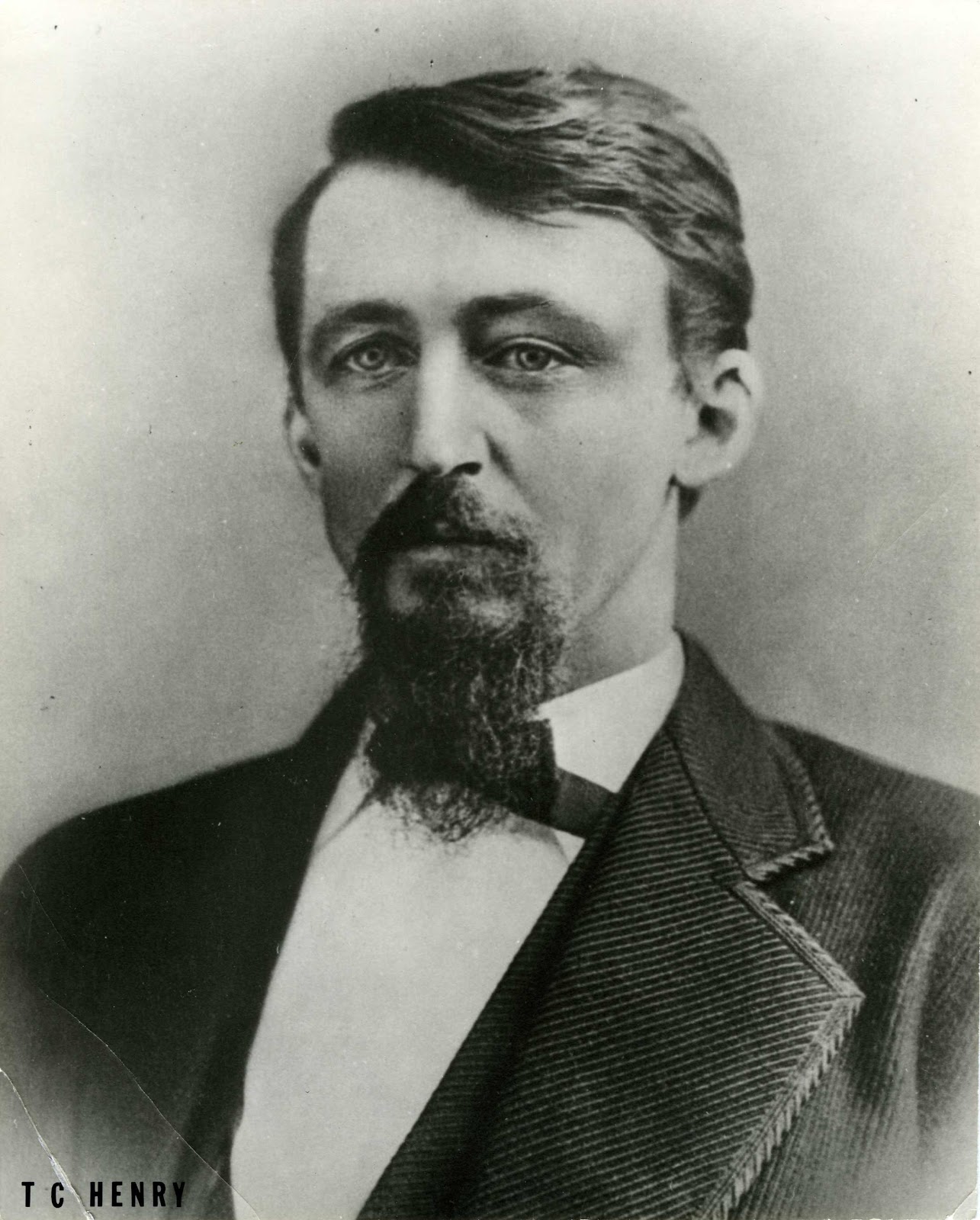
T.C. Henry: The Wheat King of Kansas

T.C. Henry
Abilene is a city with an eclectic history.  Whether it is the cattle trade, greyhound history, notable figures, or farming, the town has had many interesting stories and events over the years.  One of Abilene's more notable people from the cattle trade days was Theodore C. Henry.

We have featured the story of Joseph G. McCoy on this blog in the past, and interestingly enough, Henry's and McCoy's stories cross paths quite a bit.  Like McCoy, Henry was an Illinoisan and a successful businessman and entrepreneur.  Henry moved from Illinois to Abilene, Kansas to help promote McCoy's stockyards and also make a name for himself in real estate.  Henry would build a large financial standing through real estate over the next few years, and by 1870, he became the provisional mayor of Abilene.

During his time as Abilene's mayor, Henry would oversee the hiring of marshal Tom Smith, who finally brought law and order to the town after three hectic years of crime and lawlessness.  Smith would enforce a strict "no firearms" ordinance in Abilene and saw the closing of many of the town's brothels.

Though Henry had profited from the cattle trade and most definitely found success in his real estate business due to the influx of people moving to Abilene, he would eventually change allegiances in 1871, and help contribute to the anti-cattle trade group, the Farmers' Protective Association.  In the winter of 1871-1872, Henry drafted the following statement:

We the undersigned members of the Farmers' Protective Association and Officers and Citizens of Dickinson County, Kansas, most respectfully request all who have contemplated driving Texas Cattle to Abilene the coming season to seek some other point for shipment, as the inhabitants of Dickinson will no longer submit to the evils of the trade.

This statement was published in multiple Kansas and Texas newspapers, and it actually worked!  Over the course of 1867-1871, several other Kansas towns had caught onto Abilene's cattle town model and replicated it to great success.  Instead of Abilene, cattle drovers brought their herds to other Kansas towns like Ellsworth or Wichita.

Though the cattle were gone and the town was in a state of decline immediately following the end of the cattle trade, Henry still found great success.  Throughout the 1870s he experimented with planting Turkey red winter wheat, a crop that was commonly thought to not grow well in Kansas.  Henry had several large yields of the crop, and by the mid-1870s was known by many as the "Wheat King of Kansas."  The work of Henry can still be seen throughout Dickinson County as this is one of the most widely grown crops in the county (and the state as a whole).  Henry's large carriage house, which used to stand near the corner of 14th and Buckeye streets in Abilene, can still be seen today at Old Abilene Town.

Monday, October 8, 2012

"C.L. Brown and Kansas Independent Telephony" is Now on YouTube

Back in July, the Dickinson County Historical Society premiered our short documentary film, C.L. Brown and Kansas Independent Telephony.  The film highlights the life of C.L. Brown, a utilities entrepreneur and humanitarian who gave back to the Kansas public in fantastic ways during his life.  Today, the independent telecommunications companies continue this tradition set forth by Brown, by giving to their communities as well.  You can watch the film below:


Principal funding for this program is provided by the Kansas Humanities Council, a nonprofit cultural organization promoting understanding of the history, traditions, and ideas that shape our lives and build community.

Monday, September 24, 2012

Special Traveling Exhibit to Highlight the Orphan Train Riders to Kansas

We are very pleased to announce that the Dickinson County Heritage Center will be host to the traveling exhibit Orphan Train Riders to Kansas, October 6th through October 31st.

This special exhibit is made possible by the Thelma Starr Workman Estate, the Humanities Division of Cloud County Community College, and the National Orphan Train Complex.

The National Orphan Train Complex in Concordia (which manages the National Orphan Train Museum) had this to say about the exhibition: “The exhibit will feature photographs and information from the Anna Laura Hill collection. Hill was a placing agent during the Orphan Train Movement, making 163 trips to Kansas to place children.

“The exhibit will also incorporate photographs from depot scrapbooks that were compiled by the late Thelma Starr Workman. Workman was a teacher at Cloud County Community College for 28 years, and published a number of poetry, fiction, and local historical books. She was also a collector and promoter of local history, and a columnist for the local newspaper.”

The National Orphan Train Museum is dedicated to the preservation of stories and artifacts of those who were part of the Orphan Train Movement. The museum features displays of Orphan Train Riders, families who took the children, placement agencies and the agents who accompanied the children on the trains, and the more recent history of collecting the stories.

Wednesday, September 19, 2012

Come to the 34th Annual Chisholm Trail Day Festival!

It’s time to saddle up and head to the 34th Annual Chisholm Trail Day Festival, on Saturday, October 6, 2012 at the Dickinson County Heritage Center, 412 S. Campbell in Abilene, Kansas from 9 am to 4 pm. The admission is $5 per adult and $2 per child (ages 3-12), sponsored by the Dickinson County Historical Society.

There will be lots of fun and activities for the whole family. We will have lots of live entertainment on the main stage featuring Classic Heart playing great music of the 50s and 60s, music that will really make you want to dance. Aaron Fowler of Wichita will also be on the main stage presenting a program entitled Oh Give Me A Home: Music and the Kansas Prairies. Our third performer on the main stage will be Dave “Zerf” Zerfas. Zerf plays Kansas Ballads and Old Cowboy songs. There will be great music and entertainment all day long.

This year the Antique Farm Show will feature International tractors and farm equipment. The special feature tractor will be International Cub owned by Gail Rodda. Registration begins at 8:00 am. There will be tractor games at 11:00 am and the Parade of Power will begin at 1:00 pm. Also there will be an antique tractor pull beginning at 2:00 pm.

There will also be a pedal tractor pull for kids four to twelve years of age. Registration will begin at 8:00 am and the pull will begin at 9:00 am. This activity will be free of charge.

If you love old cars then you won’t want to miss the Antique and Classic Car Show. There will be over 50 antique and classic cars on exhibit throughout the day. Anyone who would like to bring a car for the show is welcome to do so. Registration will begin at 8:00 am Saturday morning.

Come and learn how old crafts were done. We will have demonstrations on blacksmithing, chair caning, bread baking, molasses boiling, pioneer cooking, lumber sawing, and much more.

Inside the Heritage Center make sure you visit the Mud Creek Quilters demonstrating the art of quilting. As a fund raiser, the Dickinson County Historical Society will be giving away a beautiful hand quilted quilt at 3:00 pm. For a donation of $1.00 you will receive a chance on the drawing, or for donating $5 you will receive 6 chances for the drawing.

There will also be a special traveling exhibit entitled Orphan Train Riders to Kansas from the National Orphan Train Museum in Concordia, Kansas inside the Heritage Center.

For $1.00 kids of all ages will enjoy riding on the 1901 C.W. Parker Carousel powered by its original steam engine. This carousel is a National Historic Landmark, a National Historic Carousel, and was voted one of the top 8 Wonders of Kansas Customs. It is truly a national treasure and everyone will have great fun taking a ride.

If you like trains, come and ride the rails as the Abilene & Smoky Valley Railroad powers up their 1919 Santa Fe 4-6-2 “Pacific” #3415 Steam Locomotive. Relive the days of steam powered trains. The train will run from 10:00 am to 3:00 pm on the hour.

During the day, visit Old Abilene Town and watch Wild Bill Hickok tame the streets of Abilene in 1871. Also you can take a ride on the Old Abilene Stage located in Old Abilene Town. On Sunday from 2:00 pm to 4:00 pm, Bill Burrows will hold a “Cowboy Jam Session” at the Alamo Saloon.

There will be children’s activities as well as arts and crafts booths, folk craft demonstrations, and the Farmers Market. Kasey the Clown and Timbo will also be roaming the grounds during the day.

Don’t miss out on the fun and the excitement at the 34th Annual Chisholm Trail Day Festival. For more information call 785-263-2681, check out our website, or visit us on Facebook

We would like to thank all of our sponsors for their continued support of the Chisholm Trail Day Festival.

Wrangler
Bert & Wetta
Solomon State Bank - Solomon, Abilene
Abilene Termite and Pest Control
Zey's Market
M & M Tire & Auto, Inc.
Family Eye Care of Abilene
First Bank of Kansas
First National Bank of Hope
Abilene Reflector-Chronicle
TCT
Great Plains Manufacturing
Wyatt Land Title Services
McKee Swimming Pools
Reynolds Real Estate
Mr. K's Farmhouse
Mid-Kansas Cooperative Assn.
Kenneth A. Hansen, D.D.S.

Drover
West's Plaza Country Mart
Pinnacle Bank
Webb Home Center
Holm Automotive Center

Longhorn
Smart Insurance
Duckwall-ALCO Stores, Inc.
Brierton Engineering

Thanks again! We'll see you at the Chisholm Trail Day Festival on October 6, 2012!

Friday, September 14, 2012

Guest Post: April 24, 1949, Davis Brothers Lives Lost in the Line of Duty

Today's post is brought to you by Amy Feigley. Amy is a member of the Dickinson County Heritage Center staff, and also works as a paraprofessional educator.

Bill and Milt Davis were known as good ole boys. They spent the majority of their lives in Abilene, were very devoted to their families, and were known in the community as kind and generous. They were not only known as peace officers, but also as peace makers. They were both doing something that they truly loved.

Sunday, April 24, 1949 began as a normal day for Sheriff Bill Davis and his brother, Deputy Sheriff Milt Davis. Little did they realize that April 24, 1949 would be their final day. The Davis brothers were summoned to an early morning disturbance at a farm house southeast of Abilene. They had no idea what lie ahead of them. 

Charles K. Rush, a dairy farmer by trade, was known to many as a crazed man, berserk at times. He had spent some of his early years in a mental institution. People found him harmless.

But, on April 24, 1949, something sparked in Charles Rush like it had no other day. By the end of the day, Rush, along with Bill and Milt Davis, would be dead and three innocent by-standers would be wounded.

Mervin Franks, Fred Yuhl and Mrs. Mae Pettriess, also had no idea what that day would bring to them. But they, unlike Rush and the Davis brothers, were lucky enough to survive.

Mervin Franks was sound asleep in a downstairs bedroom and was awakened by the sound of a bathroom light. As he turned and looked in the doorway, there stood Rush, his brother-in-law, with a shotgun. Franks, after being shot, played dead to protect himself from Rush.

Fred Yuhl, who was a neighbor to Rush, was shot when he approached the house. His sole purpose of going to the house that day was to tell Rush about a garage fire. Shot in his neck, chest and right arm, he was able to survive that horrific day.

Mae Pettriess was employed at the time as Rush’s housekeeper. She was shot through the right shoulder and arm. She was considered the most seriously injured of the survivors. Her arm was saved, but she suffered from shock.

The Davis brothers were murdered by Rush as they tried to enter his home from different doors. Their bodies were burned after Rush set his house on fire. Rush’s charred body was also found in the remains of the house. It was believed at the time that he escaped and was still at large and in the area.

April 24, 1949 still probably lives in the minds of many people. A day they would soon forget is a day that will never be forgotten. The following year, a granite memorial was erected in honor of the Davis brothers and placed at the Abilene cemetery, where they are buried on a hillside. Over 1,000 mourners attended the funeral for the brothers. They were heroes of this town, loved by all and will not too soon be forgotten.

Thursday, August 30, 2012

Upcoming Exhibit at the Jeffcoat Museum to Focus on the Studio's History

The Jeffcoat Photography Studio Museum in Abilene, Kansas is proud to announce a new exhibition highlighting the history of three generations of photographers in the Jeffcoat Studio family business.

Before the turn of the twentieth century, Lucy Fritz Jeffcoat trained herself in camera operation and retouching photographs.  She quickly found work for several photographers in the Abilene area.  Lucy was also the mother of four children, so she did most of her photographic work from her home.  Her son, Paul, became interested in the photographic process at a young age.  He began delivering his mother’s retouched photographs and was fascinated with the developing process.

Paul went into business as the Jeffcoat Photography Studio in 1921.  At the time, the studio was located in a small second story room in downtown Abilene.  The business soon outgrew this space, and Paul built a new building for the business in 1925.  This building still stands today, and is the current home of the Jeffcoat Photography Studio Museum.

Paul saw his business through the Great Depression, and was able to supplement his income by partitioning his building and renting half of his property to other area businesses.  Over the years, the north side of the building would be occupied by an optometrist, an insurance agency, and a shoe repairman.  The sound of pounding hammers repairing shoes could be a bit distracting during portrait sessions, but having these businesses next door helped the Jeffcoat Studio immensely. 

Paul passed the trade of photography down to his son, Bill.  Throughout his life, Bill was interested in documenting life and events in his hometown of Abilene.  Bill photographed several parades, visits from President Eisenhower, and of course, family portraits.  He enjoyed photography outside of his professional work, walking around Abilene and snapping pictures of anything that caught his eye.  His father, Paul, saw this differently.  He once told his son not to take photographs unless he could make an income from the image.  Bill would continue taking snapshots, choosing to develop his film at night to keep it a secret from his father.

Though the Jeffcoat Studio was primarily a portrait studio, the Jeffcoats were able to document the history of the Abilene area, creating images that will last several years to come.  The Jeffcoat Photography Studio Museum’s newest exhibit, The Family Behind the Lens: A Retrospective of the Jeffcoat Studio, begins on September 1 and runs through November 20.

You can learn more about the history of the Jeffcoat Studio and the history of Abilene by visiting the Jeffcoat Photography Studio Museum at 321 N. Broadway Street in Abilene.  For hours of operation or to schedule a private viewing, contact the museum at (785) 263-9882 or jeffcoatstudio@att.net.  Be sure to visit the museum’s website at jeffcoatstudio.com and their Facebook page at facebook.com/jeffcoatstudio.

Wednesday, August 15, 2012

Historical Bicycle Tour Coming Up in Abilene

The Dickinson County Historical Society will once again be conducting a historical bicycle tour of downtown Abilene.  This tour benefits the Quality of Life Coalition, and will be held on August 24, 2012 at 7:00pm.


Wednesday, July 25, 2012

Great Interaction at our Short Film Premiere

Our premiere's audience.
For the past seven months, the Dickinson County Historical Society has been working on a short film highlighting the life of C.L. Brown and his lasting legacy of community giving that still exist in Kansas independent telephone companies today. On Saturday, July 21, 2012, we premiered the fifteen-minute film, C.L. Brown and Kansas Independent Telephony, to a crowd at the Eisenhower Presidential Library auditorium. I was hoping for a good-sized crowd for the event. What we got far exceeded my expectations.

That evening, we totaled 165 guests for the film screening. That’s right, 165 people. This total was more than would fit in the auditorium’s seats, but staff at the Eisenhower Presidential Library graciously set up additional chairs so everyone in attendance could have a place to sit.

After the screening, we also held a panel discussion focusing on the history of C.L. Brown, community engagement, and how the short film was made. I was very pleased with the variety of questions our audience posed and the many stories that were shared during the discussion. Many of our audience and their families have strong memories of the Brown Memorial Park, so it was fascinating to hear those people reminisce about the past.

After the discussion, we hosted our annual Ice Cream Social at the Dickinson County Heritage Center. This was probably the largest crowd we have ever hosted for this event. Our museum was a packed house, but everyone seemed to be in high spirits throughout the evening.

I would like to thank everyone who helped make this short film and event a success, and would like to thank our society’s membership for coming out in full force Saturday night. If you were not in attendance, we will be announcing other ways to view the short film very soon.

For another take on this evening, be sure to read the Abilene Reflector-Chronicle’s writeup on the event. 

Principle funding for this program is provided by the Kansas Humanities Council, a nonprofit cultural organization promoting understanding of the history, traditions, and ideas that shape our lives and build community.

Thursday, July 5, 2012

C.L. Brown, Kansas Independent Telephony, and a Spirit of Giving

C.L. Brown
Abilene, Kansas will soon be host to the premiere of a short film on one of the city’s most influential people who often times has been unheralded in the past. On July 21, the Dickinson County Historical Society will present C.L. Brown and Kansas Independent Telephony, a look at notable Abilene patriarch Cleyson L. Brown and the spirit of giving that he inspired for Kansas independent telecommunications companies that continues today. After becoming a successful businessman in the early twentieth century, Brown decided to focus on many community improvement projects late in his life. Whether you know it or not, the legacy of Brown can be seen in the area around Abilene, and Kansas as a whole to this day.

Brown was born February 3, 1872 in Brown’s Mill, Pennsylvania. He was the oldest of Jacob and Mary Brown’s five children. The family decided to move to Dickinson County, Kansas with a sect of the Church of the Brethren in 1880. Jacob Brown owned a grist mill on the Smoky Hill River south of Abilene. At the mill, the Browns would saw wood and grind grain for local farmers. C.L. helped with various work at a young age, and was met with an accident at the age of nine. In 1881, C.L.’s right elbow was crushed by a piece of equipment.

The damage was too severe, and his arm was amputated soon after the event. Throughout most of his daily life, Brown would wear an artificial arm and hand, covered by his sleeve and a glove. Later in his life, Brown was known to muse that if it had not been for this accident, he likely would have been a farmer.

After graduating from Abilene High School, Brown worked as a school teacher, attended business college, and worked as the manager of a creamery in Wichita. In 1898, he started Abilene Electric Light Works with his father. Jacob Brown’s grist mill was converted to be a source of Abilene’s electric power. This company grew and grew, eventually becoming the United Power and Light Company in 1924.

Brown Telephone Company linemen.
Due to the success of his electric company, Brown decided to build a local telephone company just one year after Abilene Electric Light Works was formed. Brown later chartered the Brown Telephone Company in 1902. Abilene quickly became filled with various electric and phone lines strung on wooden poles. After much growth, Brown’s telephone company was renamed the United Telephone Company in 1911. In 1914, Brown and his associates decided to sell controlling interest in the company’s stock to the Missouri and Kansas Telephone Company (later Southwestern Bell). This allowed for United to have enough money to expand, and Brown was still manager of his business.

Brown built himself a large empire of companies throughout the early 1900s, having 85 companies to his name. In addition to electricity and telephone service, Brown also owned oil and refining companies, shoe stores, insurance companies, and Piggly-Wiggly grocery stores.

Having amassed a great fortune and large business empire, Brown decided he should give back to his community. He had been concerned for others for quite some time, ordering all of his employees to save ten percent of their income for future expenditures. Additionally, he had honored employees who saved money with “honor pins” for their commitment. This mandatory savings plan would come in handy for many employees after the stock market crash in 1929.

However, it would not be until 1926 that Brown began making visible gifts to the Abilene community as a whole. Brown and his siblings formed the Brown Memorial Foundation in memory of their parents. With the foundation, they constructed the Brown Memorial Home for the Aged and a 226 acre park open to the public. At the time, the park cost approximately $1,000 a day to operate. However, it was free to the public and included a swimming lake, golf course, zoo, and camps for boys and girls.

Brown once said, “Every man tries to accumulate wealth and it’s all to buy six feet of ground. Others enjoy the fruits of his effort and he never can see how much they enjoy it. But I want to see people enjoy mine while I am still alive.”

Brown Memorial Park was a huge attraction in its day. The lake was often filled with swimmers and canoes. Local Sea Scouts would practice sailing skills on a massive ship that sat in the lake. Weekend visitor totals consistently reached over 5,000 people, occasionally reaching as high as 20,000 people. It seems hard to believe today, that Brown’s Park drew in so many people, and was considered a major amusement park for the area, and was free to the public.

During all of this, Brown still focused a great deal on his businesses. In 1931, during the Great Depression, Brown opened the Sunflower Hotel in downtown Abilene. It was known as one of the grandest hotels between Kansas City and Denver. Though Brown opened this hotel in 1931 and appeared to be doing well financially, the Great Depression would take its toll on his businesses very soon.

The Great Depression greatly weakened Brown’s business empire in the 1930s. This was largely due to Brown’s persistent effort to continue funding business ventures that were making less and less income, such as the Piggly-Wiggly grocery store chain. Brown died on November 12, 1935. He was bankrupt at the time of his death.

Many aspects of the Brown Memorial Park had to be closed over the years after Brown’s death due to lack of funding and damage from the 1951 flood. However, the Brown Memorial Home still continues to offer affordable housing for senior citizens, camping is still offered for youth in scouting programs, and residents around the area are still welcome to enjoy visits to the park. The Brown Memorial Foundation is still an active force in the Abilene area, supporting area projects and scholarships for students.

Though the financial situation of the Brown businesses looked grim at the time of Brown’s death, the United companies continued to grow and expand. United Utilities pulled out of bankruptcy in 1938 and grew through the acquisition of many smaller companies over several years. The company went through many changes over the years, but continued to grow and grow long after Brown’s death. In 1986, United (then known as United Telecommunications) consolidated with Sprint. United purchased controlling interest in Sprint in 1989, and adopted the Sprint name soon after due to the company having better brand recognition.

The legacy of C.L. Brown still continues to be seen in Abilene. With all that remains of Brown’s legacy: the Brown Memorial Foundation, park, Memorial Home, Sunflower building, Brown Mansion, and the memories of Abilene’s residents; C.L. Brown lives on to this day.

C.L. Brown and Kansas Independent Telephony is a short documentary highlighting Brown’s story and the benefits independent telecommunications companies offer to the Kansas public. The film will premiere on July 21 at 6:00pm at the Eisenhower Presidential Library auditorium and is free to the public. A brief panel discussion will follow the screening, featuring the project’s staff. The Dickinson County Historical Society also welcomes the public to visit the Dickinson County Heritage Center and Museum of Independent Telephony immediately after the program, where refreshments will be served. For more information about this event, please contact the Dickinson County Historical Society, (785) 263-2681, heritagecenterdk@sbcglobal.net.

Principal funding for this program is provided by the Kansas Humanities Council, a nonprofit cultural organization promoting understanding of the history, traditions, and ideas that shape our lives and build community.

Tuesday, July 3, 2012

Memories of the Prairie Lecture Series: Lt. Frank Baldwin and the Indian Territory Expedition of 1874

Dan Holt, former director of the Eisenhower Presidential Library and Museum, will be the speaker for the next Memories of the Prairie program sponsored by the Dickinson County Historical Society on Saturday July 7 at 7:00pm at the Dickinson County Heritage Center located at 412 S. Campbell Street in Abilene.

Between the years of 1867 and 1875, some of the worst Native American conflicts took place in Kansas.  Most of the raids and attacks were along the new railroad being built along the Smoky Hill Trail.  Dan Holt's program, entitled Lt. Frank Baldwin and the Indian Territory Expedition of 1874, tells the story of an expedition directed by General Nelson Miles, a result of American Indian raids by the Comanche, Kiowa, and Southern Cheyenne in Kansas, Oklahoma, and Northern Texas.  This purpose of this expedition was to put down these raids and return these people to the reservation.  Forts Larned, Wallace, and Dodge in Kansas were all involved.  Baldwin, of the Fifth US Infantry, won his second Medal of Honor during the expedition for rescuing two girls captured by the Cheyenne along the Smoky Hill Trail.

Dan Holt began working on this story at the Kansas Historical Society, where he served as assistant manuscript curator 1963-1964.  The original version of his work was published by the Kansas City Westerners in 1965.  He had access to Frank Baldwin's diary and a wealth of primary sources and became interested in the different aspects of what was known as General Phil Sheridan's Southern Plains campaign.  He will focus on one part of the campaign, the Indian Territory Expedition of 1874, and specifically on the exploits of Lt. Frank D. Baldwin.  Baldwin was awarded two Medals of Honor, one in the Civil War, and one for his rescue of the girls captured by the Cheyenne on the Smoky Hill Trail near Fort Wallace, Kansas.

Contrary to popular stories about Indian campaigns, over half of the troops on this expedition were infantry, not cavalry.  On the other side, these Native American tribes' living conditions were destitute.  Some of the names included in this campaign are well known, including Bat Masterson.

The commentary in Baldwin's diary, Kansas newspapers, and officers on the expedition regarding the Inidan Bureau and Indian Agents, particularly the Quaker Indian agents' policy of "friendly persuasion," clearly reveal the differences of opinions on the causes and possible solutions related to the reasons for the tribes leaving the reservations and how best to convince them to return.

This Memories of the Prairie program is free of charge, however donations are always welcome.  For more information on the program or about how you can become a supporting member of the Dickinson County Historical Society, please call (785) 263-2681, or visit www.heritagecenterdk.com.

Wednesday, June 27, 2012

Memories of the Prairie Lecture Series: Presentation Explores Kansas Opera Houses

The Dickinson County Historical Society and the Heritage Homes Association of Dickinson County in Abilene will host “Kansas Opera Houses and Community Events,” a presentation and discussion by Jane Rhoads on Saturday, June 30 at 7 pm  at the Dickinson County Heritage Center located at 412 S. Campbell St.  Members of the community are invited to attend the free program.  Contact the Heritage Center at 263-2681 for more information.  The program is made possible by the Kansas Humanities Council.

 This program is part of the Memories of the Prairie Lecture Series presented by the Dickinson County Historical Society. All the programs are free, however donations are always welcomed.  You are also invited to become a member of the Dickinson County Historical Society to help support the continuing efforts to preserve the heritage of Dickinson County.

From melodrama to Shakespeare, from church socials to high school commencements, the opera houses of Kansas made significant contributions to the state’s social and cultural fabric in communities both large and small.  Rhoads will discuss the history of opera houses in Kansas and how they are being used today.

Rhoads is an author and a 2009 Notable Kansas Book award winner.  Her book, “Kansas Opera Houses, Actors, and Community Events 1855-1925” is the result of years of travel across Kansas to research opera houses.

“I came to love opera houses when as a small child I played in the opera house built by my great-grandfather,” shared Rhoads.  “This eventually led to my visiting 400 Kansas communities to learn about the activities that took place in the local opera houses and to photograph the state’s remaining ones.”

“Kansas Opera Houses and Community Events” is part of the Kansas Humanities Council’s Kansas Speakers Bureau featuring presentations and discussions about Kansas and what it means to be a Kansan over time and across generations.                         

The Kansas Humanities Council conducts and supports community-based programs, serves as a financial resource through an active grant-making program, and encourages Kansans to participate in their communities.  For more information about KHC programs contact the Kansas Humanities Council at 785-357-0359 or visit online at www.kansashumanities.org.

For more information about “Kansas Opera Houses and Community Events” in Abilene contact the Dickinson County Historical Society at 785-263-2681 or visit www.heritagecenterdk.com.

Monday, June 11, 2012

Memories of the Prairie Lecture Series: A Rose by Any Other Name

The Dickinson County Historical Society will present A Rose by Any Other Name, a first-person portrayal of Rose Kretsinger by Debbie Devine on Saturday June 16 at 7:00pm at the Dickinson County Heritage Center in Abilene, Kansas.  This program is part of our Memories of the Prairie lecture series.

Rose Kretsinger was co-author of one of the most highly celebrated quilting books, Romance of the Patchwork Quilt in America in the early twentieth century.  Two of her award-winning quilts were named the top one hundred quilts of the twentieth century.  Rose was born in Hope, Kansas in 1886, and became one of a talented group of quilters in Emporia, Kansas during the first part of the twentieth century.  Rose's influence and encouragement fostered exquisite design and applique quilting techniques among the quilters who produced elegant applique quilts that are still admired and appreciated today.  Rose is in the National Quilters Hall of Fame.  Rose died in 1963 after a long, creative life.  Her designs and willingness to share them live on in this historic performance by Debbie Devine.

Debbie brings Rose back to life in a historic portrayal, sharing Rose's life story as well as her quilting design philosophy and techniques.  Debbie has completed extensive research about Rose and is grateful to have been able to interview Rose's son Bill, and her grandson John and his wife Claudia.  Debbie has also developed her portrayal based on information about Rose obtained at the Lyon County Historical Society and the Spencer Museum at the University of Kansas, which is the repository for quilts Rose made during her lifetime.  The performance is also based on information from research about Rose published by Barbara Brackman, Jonathan Gregory, and others.

Debbie used her background as a researcher and quilter for this endeavor.  During her tenure at the University of Florida, she was named one of the top fifty researchers on campus.  She, like Rose, loves applique quilting and has used her quilting passion to recreate some of Rose's patterns and techniques.  In preparation for this historical portrayal, Debbie has taken historic performance classes at Ride into History, offered by Dr. Joyce Thierer (a.k.a. Calamity Jane) and Dr. Ann Birney (a.k.a. Amelia Earhart).  Debbie's goals for her performance are to honor Rose Kretsinger and her accomplishments with an interesting and entertaining recreation of this oustanding quilter role model.

The Dickinson County Historical Society is proud to have Debbie as a presenter for this year's Memories of the Prairie lecture series.  The program is free of charge, however donations are always welcome.

Tuesday, May 29, 2012

Guest Post: National Preservation Month

Today's post was featured in our museum's recent summer newsletter, and was written by Jeff Sheets, Director of the Dickinson County Historical Society.

The month of May is National Preservation Month and this year’s theme is “Discovering America’s Hidden Gems”. The Dickinson County Historical Society, Abilene Heritage Commission and the Heritage Homes Association would like to encourage our residents to explore the hidden gems in Dickinson County. There are many historical gems throughout the county. 

There are 31 properties, four historic districts, two bridges and one steam locomotive listed on the National Register of Historic Properties and one National Historic Landmark in Dickinson County, the C.W. Parker Carousel. In addition, the Heritage Homes Association has marked over 50 homes throughout the county. 

The Dickinson County Historical Society was founded in May 1928 for the purpose to preserve the history of the county. Since that time the historical society has continued to collect and preserve the heritage of our county. The Dickinson County Historical Society was instrumental in creating awareness of the importance of preserving the historic properties in the county. Under the guidance of the historical society a survey was conducted for the city of Abilene in 1979. Also the preservation committee of the Dickinson County Historical Society established a historic driving tour of the county and developed a historic home tour. 

From these efforts the Heritage Homes Association was created. The HHA wanted to develop an organization that would research and document historic homes that were over 50 years old. The idea of the HHA was to mark the home with a plaque that would remain with the home no matter who owned the property. Since their creation, this organization has marked over 50 homes throughout the county. The Heritage Homes Association published a book The Historic Homes of Abilene, in 1994. This organization also took over the historic homes tour and created the annual Homes for the Holidays tour that takes place the first weekend of December. The Heritage Homes Association continues to research and mark homes in Dickinson County. 

The Abilene Heritage Commission came about because of the many historic preservation efforts that were going on in Abilene started by the Dickinson County Historical Society and the Heritage Homes Association. The community saw a need to continue historic preservation and the Abilene City Commission passed an ordinance creating the Heritage Commission in 1996. Along with creating the Heritage Commission, the ordinance also allowed Abilene to become a Certified Local Government. As a Local Certified Government, the Heritage Commission entered into an agreement with the Kansas State Preservation Office to monitor local environment reviews for protecting historic properties, to educate the public on historic preservation issues, and to keep an inventory of all historic properties in the city limits of Abilene. 

The benefits of historic preservation come in many forms. The prime benefit of historical restoration is always education. It also includes both public and private benefits. Historic preservation safeguards a community's heritage, making it available to future generations for civic enjoyment and educational activities. Preservation stabilizes property values and strengthens local economies. In addition, the conservation and maintenance of historic resources and scenic areas fosters civic beauty and bolsters community pride. Finally, historic preservation has been successfully employed to improve business opportunities in many locales. 

Please take the time to discover the hidden gems throughout our county .We need to learn to enjoy our heritage.