Wednesday, January 9, 2013

Guest Post: Recollections of World War II

Doris and John Larson

Over the course of this year, we will sporadically feature stories on World War II from local Dickinson County residents, interviewed and written by Amy Feigley. 

The year was 1941. People were doing the East Coast Swing to Tommy Dorsey, the Andrew Sisters and Glenn Miller. Citizen Kane and Here Comes Mr. Jordan were drawing crowds to the movie theaters. Life was grand for all until that fateful Sunday in December when Pearl Harbor was bombed. Life suddenly changed for everyone. 

DORIS (HOOVER) LARSON 

For Doris Larson, helping with the war effort back home was something that she proudly did. She started working at Ehrsam’s in Enterprise at the end of 1943. “We got used to working a certain shift and then got rotated. I learned to run a lathe and a flange machine for a plane” says Doris. “I then worked in the drafting room and started to draw the legs for the elevators and punch boards.” 

Doris (Hoover) Larson enjoyed reminiscing about her high school days, when she met John (her future husband) and life was great. “We met at the fair in Abilene one night” says Larson. “When we were back at school, Glen Dalton passed me a note from John saying that he wanted a date with me. His parents were going to be in California and he was going to have a party. I knew that would not turn out well, so I didn’t go.” 

Fast-forward to 1941, for 20 year old Doris, this day would be embedded in her memory forever. “John was in the service and more and more men were being called into the service, including my brother Dale” says Larson. John was stationed in Olathe, then went to Virginia for training camp, then was off to San Diego, California and was eventually sent overseas to Okinawa, Japan, where he was a mine sweeper. 

While stationed, John was granted leave and returned to Olathe. On March 12, 1944, he and Doris were married. She took a leave of absence to be with her husband. When he returned overseas, she returned to Ehrsam’s and lived with her sister and brother-in-law Miriam and Loren Nichols. 

In 1945, John was granted another leave, this time to San Diego, California. Doris hopped on a train and joined him. Like most wives, she was anxious for the war to end and for her husband to return home. She eventually got her wish. 

When the war ended, Doris was pregnant with her daughter Susie. She was still working at Ehrsam’s, but left the company three weeks before Susie was born. John returned home from overseas on December 15, 1945 and eight days later on December 23rd, daughter Susie was born. Doris had many concerns when John returned home, such as where they were going to live and what was John going to do. John and Doris eventually rented a home near his folks and he began farming with his father. “We made that little house as homey as possible. There was no electrical power at all. We had a lamp from John’s grandmother that we used, as well as a lantern” said Doris. 

That next spring, Doris was anxious to plant a garden. John had borrowed a walking horse and plow and made a garden space for her. They eventually bought cattle from a neighbor so they would have milk, cream and butter and family members brought them pullets so they could have eggs. 

“Things are much easier now than they were back then. We did not have the conveniences that we do now. But, I would not have changed a thing.” Doris and John were married for 59 ½ years before he passed away. They raised two daughters together and shared a life of love and happiness, through good and bad times.

Friday, December 21, 2012

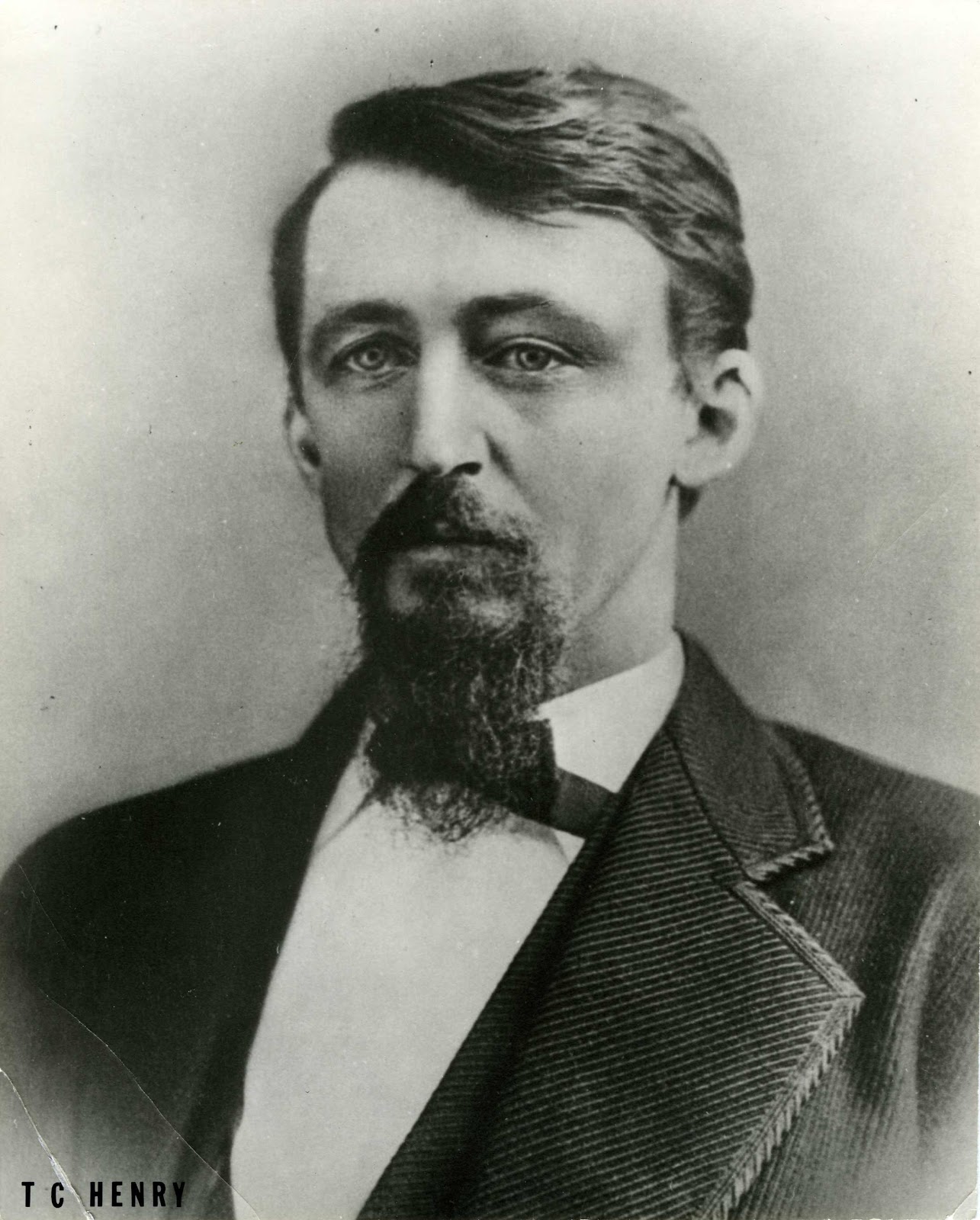
T.C. Henry: The Wheat King of Kansas

T.C. Henry
Abilene is a city with an eclectic history.  Whether it is the cattle trade, greyhound history, notable figures, or farming, the town has had many interesting stories and events over the years.  One of Abilene's more notable people from the cattle trade days was Theodore C. Henry.

We have featured the story of Joseph G. McCoy on this blog in the past, and interestingly enough, Henry's and McCoy's stories cross paths quite a bit.  Like McCoy, Henry was an Illinoisan and a successful businessman and entrepreneur.  Henry moved from Illinois to Abilene, Kansas to help promote McCoy's stockyards and also make a name for himself in real estate.  Henry would build a large financial standing through real estate over the next few years, and by 1870, he became the provisional mayor of Abilene.

During his time as Abilene's mayor, Henry would oversee the hiring of marshal Tom Smith, who finally brought law and order to the town after three hectic years of crime and lawlessness.  Smith would enforce a strict "no firearms" ordinance in Abilene and saw the closing of many of the town's brothels.

Though Henry had profited from the cattle trade and most definitely found success in his real estate business due to the influx of people moving to Abilene, he would eventually change allegiances in 1871, and help contribute to the anti-cattle trade group, the Farmers' Protective Association.  In the winter of 1871-1872, Henry drafted the following statement:

We the undersigned members of the Farmers' Protective Association and Officers and Citizens of Dickinson County, Kansas, most respectfully request all who have contemplated driving Texas Cattle to Abilene the coming season to seek some other point for shipment, as the inhabitants of Dickinson will no longer submit to the evils of the trade.

This statement was published in multiple Kansas and Texas newspapers, and it actually worked!  Over the course of 1867-1871, several other Kansas towns had caught onto Abilene's cattle town model and replicated it to great success.  Instead of Abilene, cattle drovers brought their herds to other Kansas towns like Ellsworth or Wichita.

Though the cattle were gone and the town was in a state of decline immediately following the end of the cattle trade, Henry still found great success.  Throughout the 1870s he experimented with planting Turkey red winter wheat, a crop that was commonly thought to not grow well in Kansas.  Henry had several large yields of the crop, and by the mid-1870s was known by many as the "Wheat King of Kansas."  The work of Henry can still be seen throughout Dickinson County as this is one of the most widely grown crops in the county (and the state as a whole).  Henry's large carriage house, which used to stand near the corner of 14th and Buckeye streets in Abilene, can still be seen today at Old Abilene Town.

Friday, December 7, 2012

Annual Appeal from Director Jeff Sheets

Dear Members and Non-Members alike:

The Dickinson County Historical Society would like to wish all of you a Happy Holiday Season and thank you for your continual support. It is that continual support that helps keep the Dickinson County Historical Society going.

2012 has been an exciting year at the Heritage Center. Through the generosity of some of our members, we were able to raise $7,000 to put new roofs on the Volkmann Cabin and the Kellogg School House. These were great accomplishments for us.

As the year comes to a close, the Board of Trustees would like to ask you to think about an end of the year donation to the Dickinson County Historical Society General Fund. Every dollar helps preserve the history of our county. Your donation can be mailed to 412 S. Campbell, Abilene, Kansas 67410 or dropped off at the Heritage Center.

The Board of Trustees would also like to suggest giving memberships as gifts to your family and friends. It is a gift that they could enjoy the whole year.

Please support the Dickinson County Historical Society in preserving the heritage of our county.

Sincerely,

Jeff Sheets
Director

To become a member of the Dickinson County Historical Society and/or learn the benefits of membership, please click here.

Heritage Center and Jeffcoat Museum to Close for the Holidays

Vern Stroda. Photograph from the Jeffcoat
Photography Studio Museum collection.


The Dickinson County Heritage Center and Jeffcoat Photography Studio Museum will be closed for the holidays, December 20 through January 1, giving our staff time to celebrate this festive season.

The Heritage Center will reopen on January 2 for normal business, while the Jeffcoat Museum will be open Mondays and Tuesdays starting January 7, and open by appointment all other days.


Thursday, November 15, 2012

Help our Quilt Giveaway!

As many of you know, we gave away a beautiful quilt at this year’s Chisholm Trail Day Festival. We would like to thank everyone who bought a chance for the giveaway, as this was a fantastic fundraiser for the museum.

We would love to have another quilt giveaway for next year, however at this time, we do not have a quilt to give away. If any of our members have a quilt they would like to donate for use in this fundraiser, we would greatly appreciate it.

Also, if anyone has other types of items they would be interested in donating for us to use in our fundraising efforts, please let us know.