Monday, January 31, 2011

C.L. Brown and his Affect on Abilene, Kansas

Someone who deserves more credit for the changes he brought to Abilene, Kansas is Cleyson LeRoy Brown.  It seems like many people forget or do not even know about what Brown did for his community.  A successful businessman, Brown decided to focus on many community improvement projects late in his life.  Whether you know it or not, the legacy of Brown can be seen in the area around Abilene to this day.
C.L. Brown.  Image courtesy of the Jeffcoat Photography Studio Museum.
Brown was born February 3, 1872 in Brown’s Mill, Pennsylvania.  He was the oldest of Jacob and Mary Brown’s five children.  The family decided to move to Dickinson County, Kansas with a sect of the Church of the Brethren in 1880.  Jacob Brown owned a grist mill on the Smoky Hill River south of Abilene.  At the mill, the Browns would saw wood and grind grain for local farmers.  C.L. helped with various work at a young age, and was met with an accident at the age of nine.  In 1881, C.L.’s right elbow was crushed by a piece of equipment. 
Jacob Brown's grist mill.  Image courtesy of the Jeffcoat Photography Studio Museum.
From the Abilene Weekly Chronicle: December 30, 1881:
“A little son of Jacob Brown met with a very serious accident on last Saturday.  His arm was caught and terribly crushed in the cogs of a power corn sheller.  It was thought at first that amputation be necessary, but an effort will be to save it, although he will undoubtedly be a cripple for life.”

The damage was too severe, and his arm was amputated soon after this report was published.  Throughout most of his daily life, Brown would wear an artificial arm and hand, covered by his sleeve and a glove.  Later in his life, Brown was known to muse that if it had not been for this accident, he likely would have been a farmer.

After graduating from Abilene High School, Brown worked as a school teacher, attended a business college, and worked as the manager of a creamery in Wichita.  In 1898, he started Abilene Electric Light Works with his father.  Jacob Brown’s grist mill was converted to be a source of Abilene’s electric power.  This company grew and grew, eventually becoming the United Power and Light Company in 1924.

Due to the success of his electric company, Brown decided to build a local telephone company just one year after Abilene Electric Light Works was formed.  Brown later chartered the Brown Telephone Company in 1902.  Abilene quickly became littered with various electric and phone lines strung on wooden poles.  When it became apparent that there were too many lines in the air, Brown decided to bury many of them throughout the downtown area.  At the time, this would not have been a common practice.  Brown’s company was renamed the United Telephone Company in 1911.  In 1914, Brown and his associates decided to sell controlling interest in the company’s stock to the Missouri and Kansas Telephone Company (later Southwestern Bell).  This allowed for United to have enough money to expand, and Brown was still manager of the company.
Linemen employed by the Brown Telephone Company.  Image courtesy of the Jeffcoat Photography Studio Museum.
Brown built himself a large empire of companies throughout the early 1900s.  There were a total of 85 companies within the Brown empire including: Brown Telephone Co., United Power and Light Co., Clear Creek Power and Development Co., Sunflower Shoe Stores Co., United Aero Co., United Life Building Inc., United Insurance Co., Sunflower Hotel Co., United Oil and Refining Co., United Pipeline Co., United Grocery Store Co. (Piggly-Wiggly Stores), and Beach Oil Co.
Abilene's 1920 Directory.  Image courtesy of the Dickinson County Historical Society.
The headquarters for the United Company in Abilene was located at the corner of Third and Cedar streets.  To this day, the building is still referred to as the United Building despite the fact that it has not been used by the former company for several years.
Image courtesy of the Jeffcoat Photography Studio Museum.
Having amassed a great sum of money, Brown decided he should give back to his community.  He had been concerned for others for quite some time, ordering all of his employees to save ten percent of their income for future expenditures.  Additionally, he had honored employees who saved money with “honor pins” for their commitment. This mandatory savings plan would come in handy for many employees after the stock market crash in 1929.
David Eisenhower (father of President Dwight D. Eisenhower) presenting C.L. Brown with the first honor pin.  Image courtesy of the Jeffcoat Photography Studio Museum.
Brown also offered living arrangements to unmarried female employees at the Lebold Mansion (a well known building in Abilene due to its age and unique architecture).

However, it would not be until 1926 that Brown began making visible gifts to the Abilene community as a whole.  Brown and his siblings formed the Brown Memorial Foundation in memory of their parents.  With the foundation, they constructed the Brown Memorial Home for the Aged and a 226 acre park open to the public.  At the time, the park cost approximately $1,000 a day to operate.  However, it was free to the public and included a swimming lake, golf course, zoo, and camps for boys and girls. 
Plan for Brown Memorial Park.  Image courtesy of the Jeffcoat Photography Studio Museum.
“Our only thought in establishing this memorial is to give in a practical manner recognition of the memory of our parents and to do some good to humanity in a permanent and helpful way that will make life easier for those who may receive its benefits.  It is located here in Abilene because it is our home and the home for so many years of our family.  We hope that it may fill a real need and be forever an active force for helpfulness.” -C.L. Brown
Brown Memorial Home around the time of its opening in 1926.  Image courtesy of the Jeffcoat Photography Studio Museum.
“Every man tries to accumulate wealth and it’s all to buy six feet of ground.  Others enjoy the fruits of his effort and he never can see how much they enjoy it.  But I want to see people enjoy mine while I am still alive.” -C.L. Brown
An aerial view of Brown Memorial Park.  Image courtesy of the Jeffcoat Photography Studio Museum.
Since it was a man-made lake, Brown built a three feet high dam and two water wheels that pumped water into the lake from the Smoky Hill River.
Brown's lake.  Image courtesy of the Jeffcoat Photography Studio Museum.
Sea Scouts on Brown's lake.  Image courtesy of the Jeffcoat Photography Studio Museum.
Brown Memorial Park was a huge attraction in its day.  The lake was often filled with swimmers and canoes.  Local Sea Scouts would practice sailing skills on a massive ship that sat in the lake.  Weekend visitor totals consistently reached over 5,000 people, occasionally reaching as high as 20,000 people.  It seems hard to believe today, that Brown’s Park drew in so many people, and was considered a major amusement park for the area, and was free to the public!
Brown Memorial Camp (for Boy Scouts).  Image courtesy of the Jeffcoat Photography Studio Museum.
Camp Mary Dell for Girls.  Image courtesy of the Jeffcoat Photography Studio Museum.
During all of this, Brown still focused a great deal on his businesses.  In 1931, during the Great Depression, Brown opened the Sunflower Hotel in downtown Abilene.  It was known as one of the grandest hotels between Kansas City and Denver.  Though Brown opened this hotel in 1931 and appeared to be doing well financially, the Great Depression would take its toll on his businesses very soon.
A look at the exterior of the Sunflower Hotel.  Image courtesy of the Jeffcoat Photography Studio Museum.
The interior of the Sunflower Hotel.  Image courtesy of the Jeffcoat Photography Studio Museum.
The Great Depression greatly weakened Brown’s business empire in the 1930s.  This was largely due to Brown’s persistent effort to continue funding business ventures that were making less and less income, such as the Piggly-Wiggly grocery store chain.  Brown died on November 12, 1935.  He was bankrupt at the time of his death.

Many aspects of the Brown Memorial Park had to be closed over the years after Brown’s death due to lack of funding.  However, the Brown Memorial Home still continues to offer affordable housing for senior citizens, camping is still offered for youth in scouting programs, and residents around the area are still welcome to enjoy walking around the park.  At first glance, you may not see much evidence of what the park used to be like, since the lake dried up long ago.  However, if you look closely, there are several stone structures still standing (including many of the structures for the zoo) and the masts of the Sea Scout ship stand close to a nature trail (since they are the only part of the ship remaining, it is a rather odd sight to see).

Though the financial situation of the Brown businesses looked grim at the time of Brown’s death, the United companies continued to grow and expand.  United Utilities pulled out of bankruptcy in 1938 and grew through the acquisition of many smaller companies over several years.  The company went through many changes over the years, but continued to grow and grow long after Brown’s death.  In 1986, United (then known as United Telecommunications) consolidated with Sprint.  United  purchased controlling interest in Sprint in 1989, and adopted the Sprint name soon after due to the company having better brand recognition.

The legacy of C.L. Brown still continues to be seen in Abilene.  With all that remains of Brown’s legacy: the Brown Memorial Foundation, park, Memorial Home, Sunflower building, Brown Mansion, and the memories of Abilene’s residents; C.L. Brown lives on to this day.

The Jeffcoat Photography Studio Museum is currently featuring an exhibit entitled: An Abilene Legacy: Images of C.L. Brown.  The exhibit features over forty photographs (a few of them shown here) and an impressive hand painted photograph of C.L. Brown made by the Jeffcoat Studio.  The exhibit will be on display through April and admission is free.  The museum is open Monday and Tuesday 9:00am-4:00pm or by appointment.  For more information on the Jeffcoat Photography Studio Museum, visit us on Facebook here.

Wednesday, January 26, 2011

Are You Listening to the Stuff You Missed in History Class Podcast?

The title says it all.  If you're not, you should.


Stuff You Missed in History Class

What Happened to the History Channel?

While the main focus of this blog is the history of Dickinson County, Kansas, I plan to focus on topics outside of the county.  So in the future, you can expect to occasionally see posts on Kansas history, US history, World history, and more.  No subject will be off limits.  To do this will be a bit more freeing for myself, and may expand interest and readership.  For this post, I would like to discuss the state of the History Channel.

In addition to my interest in history, I am an avid television watcher.  I watch all kinds of programs: sitcoms, dramas, news, documentaries, etc.  Being a history nerd though, I watch the History Channel fairly often.

Many people used to affectionately (or maybe not so affectionately) refer to the History Channel as the “Hitler Channel.”  Of course, this was because the channel mostly featured programs about World War II.  Nowadays, the History Channel does not have to worry about being called this, as a number of changes have been made in their programming lineup.

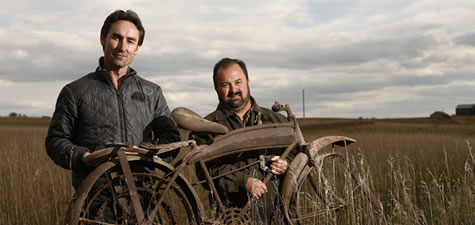
My main concern with the History Channel is that it does not feature enough programs about history.  Let’s take a quick look at the channel’s list of programs.  A full list can be found here.  What I would consider to be the History Channel’s biggest shows are: American Pickers, Pawn Stars, and Ice Road Truckers.  All of these are fine reality shows in their own right, but are they about history?  I suppose you could call American Pickers and Pawn Stars history programs since you learn a little bit about the history of many of the objects that are encountered in each show, but these moments are few and far between one another.  The channel has a number of other reality shows such as Top Gear, Top Shot, and Ax Men.  Like the previous shows mentioned, most of the History Channel’s reality shows have a loose connection to history.
American Pickers
Let’s move on to another type of show that the History Channel has a lot of these days, conspiracy theorist programs.  It seems like every time I turn to the History Channel, it is either a show about aliens or the apocalypse.  I understand the interest in these shows.  It is fun to think about aliens building the pyramids, or someone thousands of years ago predicting the end of days.  But there is not enough historical evidence to these types of claims.  But you never know, maybe in a year or so I’ll be exclaiming, “Nostradamus was right!” if the world comes to an end.  Until then, I will still be baffled as to why the History Channel has to have so many of these types of shows.

Even though I do have some complaints about the state of the History Channel, I do still enjoy tuning in.  I really enjoy American Pickers, even though I think it should probably be on a different station.  The History Channel does continue to air a fair amount of historical shows like America: The Story of Us and WWII in HD.  Nevertheless, it would be nice if the folks in charge of the History Channel made more of an effort to get young people interested history by creating more new shows entirely dedicated to history.  I want to see a show that lives up to the History Channel name.  But who knows?  Maybe Only in America with Larry the Cable Guy (premiering February 8) will be that show.  I’m not counting on it though.
Will this man save the History Channel in my eyes?  Probably not.

Tuesday, January 25, 2011

The Statehood of Kansas

In case you didn't realize, January 29 marks the 150th anniversary of the statehood of Kansas.  To commemorate Kansas Day, this week's post is devoted to the story of the state.  If you are a member of the Dickinson County Historical Society, you may have already read this, since it was printed in our recent newsletter.  Nevertheless, enjoy!


This year marks the 150th anniversary of the statehood of Kansas.  Just a few years before becoming a state, the area that became Kansas went through a major transformation as communities grew and as the state government became established.

Primarily, the people seen in the Kansas region prior to 1854 were travelers passing through, traders, soldiers, missionaries, and Native Americans.  For several years explorers such as Zebulon Pike, Stephen Long, and John Frémont passed through, and trails such as the Santa Fe and Oregon Trails promoted trade and expansion in the land west of Kansas.  People were coming to Kansas, but not to live there.  Several Native American tribes were forced onto the land due to the Indian Removal Act of 1830.  For several years, Kansas was considered an Indian Territory, and therefore was uninhabitable for settlers moving west.

In May 1854, the Kansas-Nebraska act opened Kansas and Nebraska as United States territories.  Also important to Kansas’ future, this bill allowed for settlers of a territory to determine if their state would enter the union as a free or slave state.  At the time of this bill’s creation, many assumed Kansas would become a slave state since neighboring Missouri was one.

Communities quickly began to grow throughout the Kansas territory.  Notably for the area that would become Dickinson County, George Freeman became the first settler of Dickinson County in 1855, and in 1857 Mr. and Mrs. Timothy Hersey organized a little town named Abilene along the bank of Mud Creek.
Even though Kansas was not close to gaining statehood, the discussion of whether Kansas would allow slavery instantly became a topic of discussion.  Antislavery groups from the east sent people to Kansas soon after it became a territory.  Several proslavery individuals moved to the territory as well.  Relations between these two groups began peacefully, but problems quickly arose.
             
On more than one occasion, Border Ruffians from Missouri illegally voted in Kansas elections for proslavery candidates.  In an 1855 election, 6,307 men voted even though there were only 2,905 eligible Kansas men of voting age (women were not allowed to vote at this time).

Blood began to be shed on both sides.  In 1856, the Free State headquarters in Lawrence was attacked.  Two newspaper offices were destroyed, and several stores were looted by a proslavery group.  Later that same year, Free-Stater John Brown and his men killed five proslavery supporters in Franklin County.  This event would infamously be known as the Pottawatomie Creek Massacre.  Attacks like these continued to happen for quite some time.  Even after Kansas gained statehood, William Quantrill and his men attacked Lawrence in 1863, burning many buildings to the ground and killing almost every person in sight.  With violence such as this occurring as early as 1856, one could argue that the Civil War actually began in Kansas.  With tension rising and attacks occurring more and more, it is easy to see why the territory and state were known as Bleeding Kansas during this time period.
             
In July 1859, the fourth constitutional convention of Kansas met in Wyandotte (now part of Kansas City).  Here, delegates completed the Kansas constitution and approved Kansas entering the union as a free state.  Later that year a provisional state government was elected.  However, the Kansas constitution was not approved by the United States Senate since it would mean Kansas would be a free state.  With many proslavery senators against this, Kansas statehood was delayed for over a year.
             
In January 1861, the South seceded from the union, and the Kansas bill was quickly passed by the remaining congress.  On January 29, 1861 the bill was signed by outgoing President James Buchanan, and Kansas became a state.  There was a great deal of celebration, but with the Civil War on the horizon, there was also a great deal of uncertainty of what would happen to Kansas and the rest of the United States in the future.

Monday, January 17, 2011

Changes Brought about by the Chisholm Trail

Last week I wrote about Joseph McCoy and his work in the cattle trade.  This week, I thought it might be nice to share some other information about what happened because of the cattle trade on a small and large level.


In addition to McCoy’s businesses opening in Abilene, several other businesses began to be seen throughout Abilene’s cattle town era.  Before McCoy’s arrival, the town had only small log and sod homes, a small hotel, and a saloon operating out of a small dugout.  By 1870 the community had ten boarding houses, eleven saloons, five general stores, and four hotels. The community had grown to accommodate over seventy-five businesses and over three thousand residents.  Most of these businesses found their income from cowboys and cattle traders.  As many as one thousand cowboys were being paid off in a single day during the cattle drive season, and they spent their money quickly in the many businesses that Abilene had to offer.
A view outside Abilene in 1867.  McCoy's hotel, the Drover's Cottage, is the building pictured in the background.  Image courtesy of the Dickinson County Historical Society.
McCoy’s Impact Outside of Abilene

The cattle trail era of Kansas had many positive effects outside of Abilene.  Prior to McCoy starting the cattle trade in Abilene; Texas, as most southern states after the Civil War, was close to bankruptcy.  By the end of the era, Texas sold nearly $150 million in beef throughout the nation.  For the first time ever, the beef industry was a national business.

Several towns in Kansas benefited from the cattle drives as well.  The six major cattle towns of the era were Abilene, Ellsworth, Newton, Wichita, Caldwell, and Dodge City.  Many other Kansas towns shipped cattle as well though.

Also, due to the Kansas cattle drives, the Kansas City Stockyards were established in 1868.  After the establishment of these stockyards, the packing industry moved to Kansas City.  After the development of refrigerated cars, the entire nation was able to have beef shipped to them.

Probably the biggest impact of the cattle drives to Kansas is the image of the cowboy.  After the success of the Kansas cattle drives, the cowboy became part of the American cultural lexicon.  The image of a man riding a horse, with a large hat, boots, and a six-shooter by his side is something that everyone thinks of when they hear the word "cowboy."  If it was not for the Kansas cattle drives that McCoy started, there is a chance that this image would not be as tremendous as it is in our American heritage.